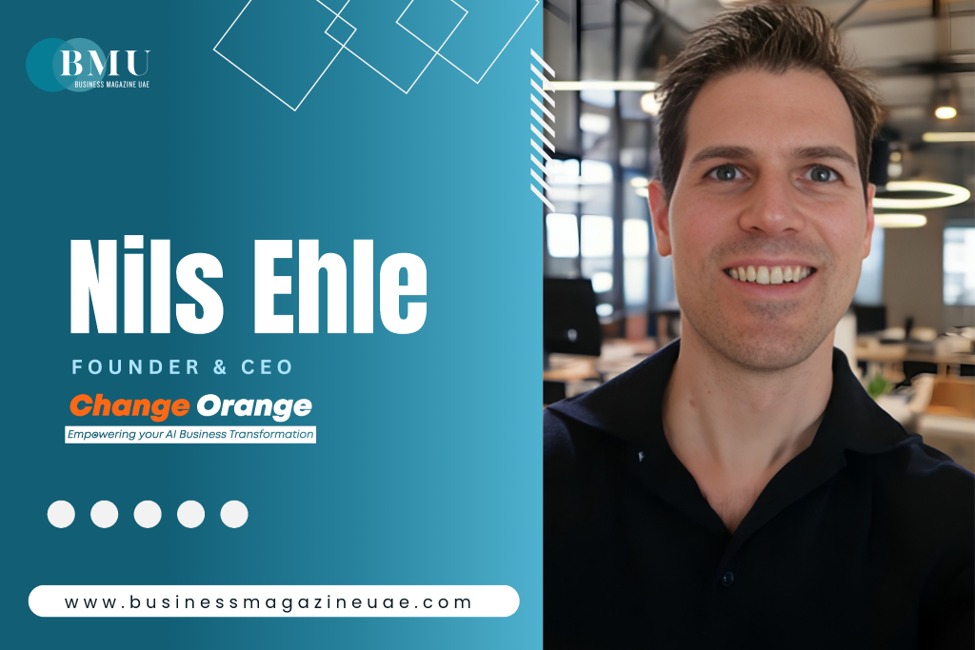
A seasoned transformation leader with two decades of experience, Nils Ehle does not see himself as someone who introduces AI into organizations — he sees himself as a facilitator of meaningful change, helping people and organizations build the capability to use AI to live up to their full potential, both organizationally and individually.
As Founder & CEO of Change Orange, Nils blends strategic foresight, technology fluency, and a conscious, people-first philosophy — guiding leaders from AI exploration to AI impact across industries.
The Beginning
We started the session by asking, “Can you tell us about your professional journey and what led you to your current role?”
Nils Ehle started by saying, “Change and business transformation have been the red thread throughout my entire career. I started in consulting at Accenture before moving to E.ON in the energy sector. At E.ON, my journey began in IT transformation and later expanded into driving change across the operational sales business, moving progressively closer to where the real business challenges existed.”
“In 2012, I was given the freedom to set up an international ‘guerrilla unit’ for business transformation across our 12 country markets, reporting directly to board level. The core problem then was that technology was still treated largely as an IT domain and rarely delivered what the business actually needed. That was the moment I went from ‘doing a job’ to thinking and operating as an innovation leader. From there, I helped build a cross-company innovation hub in Germany’s industrial heartland, the Ruhr Valley, bringing together around 80 organizations — corporates, including direct competitors of my own employer, E.ON, mid-sized companies, startups, universities, and public-sector institutions. The work focused on driving regional digital transformation by matching the right startup solutions to the right business problems, while helping organizations adapt their practices and culture to the adoption challenges of an increasingly VUCA world.
In 2015, I founded Change Orange. What began alongside my corporate role has now become my full focus. Starting out as a boutique consultancy focused on redesigning organizations to become more customer-centric and innovative, Change Orange today is fully focused on empowering organizations to master AI business transformation — moving beyond hype and capturing real, measurable business value in a human-first way.” Nils further added.
AI Business Transformation: Making the Right Choices
Eager to learn how Nils decides what to focus on, we asked, “What is your approach to deciding which business and technology trends and client engagements to lean into?”
“To stay relevant in this work, you have to be a good observer of what is happening in the world — and a visionary about where things are going. The only way to do that is to refuse to get stuck on the skills and projects you have done in the past. You have to be ready, again and again, to reinvent yourself. AI is the current layer to embrace — and it is fundamentally a business skill, not just a technology topic.”
“How I engage with companies on these matters as much as what I bring. Change management does not work if you only push against resistance — you need fertile ground, people willing to explore, dedicate time, step into uncertainty, and question old business models. Right now, AI creates a lot of external pressure on companies, and that helps. But the engagements I lean into are the ones where I see a real spark — a fire, a spirit of wanting to do things themselves — not just a fear-driven push to cut costs with AI without any thought for the meaningful change it could drive for people.
Underneath all of this sits a simple principle: if you want to stay relevant, you cannot stay in your comfort zone — not as a company, not as an individual. You always have to feel a little uncomfortable. Comfort is where reinvention quietly dies. And I want to be honest with the leaders reading this: that discomfort is not a problem to solve. Every serious leader I work with feels it. The ones who do well learn to recognize it as a signal that something real is happening.”
Business AI Readiness
We followed up by asking, “Once a company has that spark, where do you actually start?”
“Many organizations get this part wrong at first, and it is completely understandable. The pressure to show AI progress is enormous, so leaders jump straight into use cases — chatbots, copilots, isolated proofs of concept — and months later wonder why nothing has scaled. AI business transformation is not a use-case sport. It is a capability-building exercise. That is why we developed our six-dimensional AI Business Maturity Model, looking at data, technology infrastructure, organization and processes, individual and team skills, the link between AI portfolio and business strategy, and leadership and culture.
And here is something I want to be very explicit about: at the end of the day, this is not really about building for AI. It is about building for resilience. A lot of companies treat AI the way someone treats the gym when they only train their biceps — impressive to look at, useless the moment something unexpected lands on them. What you actually need is core strength: a strong back, strong legs, and a strong core. The world we used to call VUCA has become VUCA Plus, accelerated by AI. That is precisely why our model is structured the way it is. Only two of the six dimensions — data and technology — are directly about AI. The other four have nothing to do with AI as such; they are about core organizational strength. AI is the current trigger; the capabilities you build are the lasting muscle.” Nils Ehle replied.
According to him, “And alongside the structural side sits a mindset dimension that matters just as much: the willingness to be comfortable in the uncomfortable. In this era, that is not a weakness. It is a strength.”
Leadership in the Age of AI
Picking up on the leadership thread, we asked, “What does effective leadership look like in the age of AI, in a VUCA Plus world?”
“Leadership is undergoing a fundamental change because of AI. AI can now take over many of the managerial tasks that used to fill leaders’ days. That is a big shift: from the management of tasks to the leadership of people. And it makes a different set of skills suddenly central. True leadership in this era is about understanding people and their needs, helping them thrive — being more of a coach than someone who simply checks on their work.”
“Leaders have to lead by example, demonstrating curiosity, building psychological safety, and creating space for people to discover where AI genuinely adds value. True transformation only works when it is lived at all levels. At Change Orange, we have distilled this into a seven-dimensional leadership model covering willingness to learn, emotional intelligence, data and technology savviness, adaptability and openness, systemic thinking and design, creativity and innovation, and the courage to change. None of these are ‘soft’ skills anymore — they are the operating system of any leader navigating this decade well.
There is an image I often come back to: the elephant. In an elephant, the heart is roughly five times heavier than the brain, and elephants are deeply empathetic, calm, and lead their herds with strength and presence. In humans, the proportions are reversed: the brain weighs about five times more than the heart. Most modern leadership is built on that imbalance — heavy on analysis, light on heart. The leaders I see succeeding in the age of AI are the ones who deliberately shift toward heart-based leadership: making decisions from a place of care, not just calculation.”
“And there is something I want to say directly to leaders feeling the weight of all this. You do not have to have all the answers. The leaders I see thriving are the ones willing to stand in front of their teams and say honestly: ‘I do not know yet — let us figure this out together.’ That kind of vulnerability is not a weakness. It is what creates psychological safety, the foundation on which everything else is built. The shift this era requires from leaders is not just a new set of skills. It is a shift in mindset and heart. And that shift starts, very simply, with permission to not have everything figured out.”
Impact of AI in Transforming Businesses
AI is reshaping every industry, so we asked, “What role do you see AI playing in transforming businesses, and what are the risks leaders need to be aware of?”
“There is no segment of the economy that AI will not touch, from customer service to the orchestration of entire business value streams, and increasingly complex knowledge work. What we are seeing now is the rise of full agentic AI ecosystems and the first AI-native companies. What excites me most when driving AI business transformation is not the technology itself; it is contributing to a future where humans remain in the lead, not just ‘in the loop,’ and AI works alongside them as a powerful tool, not as an equal.
AI should not be humanized. It is not a teammate, it is a powerful capability space that enhances human potential, and people remain responsible for the outcomes.”
“What this enables, when done right, is genuinely positive. Humans can hand over routines and repetitive coordination to AI and step into what human potential is really about: original thinking, creativity, judgment, deep relationships, and meaning. But the biggest risk is not AI itself. The biggest risk is humans giving up their own potential, becoming passive, letting AI think for them, instead of actively shaping change.
Recent research from MIT’s Media Lab on ‘cognitive debt’ shows that when people lean too heavily on AI, their own cognitive engagement drops measurably. I know how hard this is when the pressure to deliver is immense, the temptation to let AI handle everything, including the thinking, is very real and very human. But the leaders who consciously resist that temptation, and use AI to free their people rather than replace their judgment, are the ones who build organizations that endure.”
Worth-Sharing Triumphs
We further asked, “What do you consider your biggest triumphs in this work?”
“My biggest triumphs are about helping others, enabling people, both at a company level and an individual level, to complete their own transformation. Honestly, I do not think you really have triumphs of your own in this work; the people you support are the actual face of any transformation. The win is empowering others so that they, in turn, can empower others.
One example that stands out is a project with the digital supply chain of a large global pharmaceutical company. We redesigned the organization, and the way we did it was unusual: we redesigned it while running it in the new way. Change on the run. People were placed into the new roles immediately and started driving the change from the inside. Within just one year, the entire digital supply chain organization had been transformed, fast, deeply, and sustainably. Not a deck on a shelf, but a working organization run by empowered people.” Nils Ehle added
He said, “Alongside the business transformation work, one of the things I am most excited about right now is the AI products we are building with our network partners — like the ‘AI Use Case Radar,’ a real-time agentic engine that breaks any company down into business capabilities, then proposes, evaluates, and prioritizes AI and RPA use cases — benchmarking each one against real-world examples, scoring them for compliance, and shaping the result into an AI use-case portfolio and roadmap.
This gives companies a strong starting point to figure out where and how to apply AI in their business. And we deliberately run the agentic engine alongside human experience and intuitive insights that AI alone cannot provide — combining Artificial Narrow Intelligence with what I like to call General Human Intuitive Intelligence.”
Envisioning the Future
We also asked, “How do you envision the future, and what should leaders prepare for now?”
Nils replied, “The most important shift is not just a shift in mindset — it is a shift in heartset. Many organizations say ‘AI first.’ I think that is the wrong mantra. The right mantra is ‘people first,’ lived from the heart. Mindset gets you to learn faster, become more open, and adapt. But heartset is what differentiates companies that are merely highly efficient from companies that actually serve. In the age of AI, when efficiency becomes a commodity, heartset will be the real differentiator.
The companies I see moving from good to great are not the ones that think more about themselves; they are the ones that think more about others. The good-to-great shift, at a company level, is fundamentally a move from an ego mindset to a service mindset. Companies that obsess over how they look or where they rank tend to plateau. Companies that obsess over how they serve tend to keep climbing.
AI does not change that equation. It simply makes the difference more visible, faster. And I want to acknowledge something here: the pull toward ego and ranking is not a moral failing. It is the gravity executives operate under. Quarterly KPIs, board demands, peer comparisons — these are real forces. The shift to service is not about pretending those pressures are not in the room. It is about choosing, again and again, to lead from a different place while they are.”
He then added, “The deeper structural shift I see is that, with AI, human language is becoming the new code. You no longer need to be a programmer to make things happen — you need a good original idea, the ability to express it clearly, and AI can translate that into working software, analysis, and almost anything. Business and domain experts are moving into the driver’s seat. What becomes truly scarce, and therefore truly valuable, are good original ideas. The future belongs to people and organizations who can think originally, lead from the heart, and combine deep domain expertise with AI to scale execution.”
Advice Shaping Nils’ Experience Path
We then asked about the principles that shaped him as a leader: “What is the best advice that has shaped your path?”
He stated, “Honestly, I am not sure I would call it a career path. The word ‘career’ suggests something moving upward, climbing a ladder. I prefer to call it an experience path because what I have lived is not a vertical line but a wide collection of experiences across countries, industries, roles, and people.
Do not follow a career path; follow your path. Listen to what your heart is telling you. The catch is that ‘feeling right’ has to come from the right place — from a perspective of service, not ego. When you act from ego, you optimize for status and comparison. When you act from service, you optimize for impact on others, and that is where the meaningful experiences accumulate.”
Beyond that, a few simple principles: be yourself. Be authentic. Be honest. Have fun at work, and do the work together with others. Almost nothing meaningful gets built alone, and it is never about me solving the problem; it is about solving it together with the people facing it.
And be fearless. Being fearless does not mean never feeling fear. I feel it, and so does every honest leader I work with. It means refusing to let fear be the deciding factor.”
The Art of Balancing
We ended the interview by asking, “How do you balance driving cutting-edge innovation with running a successful consulting practice — and staying grounded as a person?”
“I do not see my work as ‘a job’ that needs to be balanced against the rest of my life. I see it as my passion. As long as I find genuine passion in what I am doing, I do not feel a need for balance — I feel a need to stay grounded.”
What grounds me is going analog. I play the handpan, go for runs, do simple physical work, and spend time in nature and with my family. Those moments are not just breaks from work — they are part of how the work happens. People say that in music, it is the pauses that create the song. The same is true for any creative work, including business and innovation. New ideas rarely arrive when you are staring at the problem; they arrive when you have stepped away,” said Nils Ehle.
He then added, “There is a deeper layer to this as well, and that is surrender. Not in a passive sense, but as a way of being — letting go of the deterministic view that you have to control everything, that life and work have to unfold in a particular way. When you operate from that controlling stance, you live from the ego, and you spend an enormous amount of energy fighting reality.”
“When you surrender, you take up what is actually given to you, and you can be in real service to it. Once you live this way, you stop trying to find balance. The balance is no longer something you achieve — it is something you are, in how you live and breathe every second.”
“Nils Ehle delivers public keynotes and in-house inspirational talks for leadership teams on topics such as leadership in the age of AI, escaping the AI PoC graveyard, and building organizations for AI business readiness.”
Follow Nils on LinkedIn, X, YouTube, and TikTok for regular reflections and inspiration on AI Business Transformation and leadership and learn more about Change Orange at www.changeorange.com.
Also Read:-
Giuseppe Vaccarella on Critical Infrastructure, Cybersecurity, and AI in Current Times
Bader Nasser Marzooq On Shaping The Future Of Luxury Fragrance
About Author