
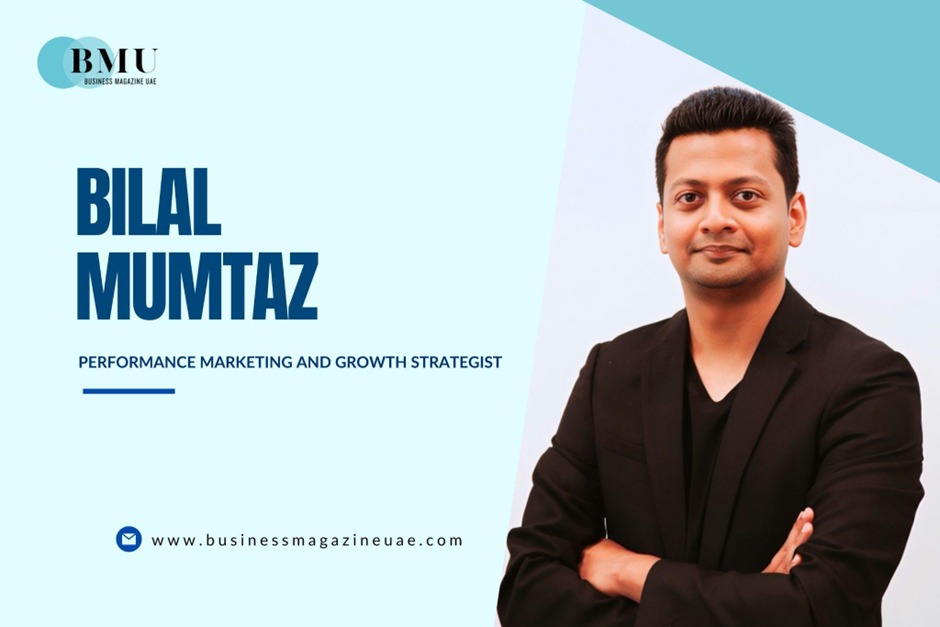
We recently spoke with Bilal Mumtaz, an accomplished leader in Growth & Performance Marketing. Having over a decade of experience in scaling business in the GCC, Bilal has earned a name for constantly bringing transformation within businesses. Over the years, he has actively helped brands ensure a strong position in competitive markets, particularly e-commerce.
Bilal plays a crucial role in elevating a company’s presence across its regional ecosystem. With a strong commitment towards performance-led growth, he not just scales revenue but has an equal focus on building sustainable growth systems. Bilal Mumtaz’s professional journey over the years is an inspiration for the next generation of leaders in the field.
Spark Behind the Journey
We started the interview by asking, “What first drew you to digital marketing and performance-driven growth, and how did your journey in ecommerce begin?”
Bilal shared, “What initially attracted me to digital marketing was the ability to directly connect strategy with measurable business impact. Unlike traditional marketing, digital gave me the opportunity to understand consumer behavior in real time, optimize continuously, and scale results through data-driven decision-making.
My journey started over a decade ago, working across telecom, finance, healthcare, and later ecommerce ecosystems in the GCC. Over time, I became increasingly passionate about performance-led growth because it sits at the intersection of analytics, psychology, technology, and business strategy.
E-commerce, in particular, fascinated me because of its speed and complexity. You’re not just running campaigns — you’re influencing the full customer journey, from discovery to conversion to retention. Working with leading regional brands allowed me to experience growth at scale, especially in app-first and omnichannel environments where profitability and customer experience become equally important.
Today, my focus is not just on scaling revenue, but on building sustainable, full-funnel growth systems that drive long-term business value.”
From Challenges to Success
Challenges are an inevitable part of every journey. To learn how Bilal Mumtaz handles obstacles in his business, we asked, “Can you share a challenging campaign or growth phase you’ve faced, and how you managed to turn it around?”
He explained, “One of the biggest challenges I’ve encountered was scaling aggressively during highly competitive seasonal periods where acquisition costs were rising significantly across platforms like Meta and Google.
The immediate reaction in many businesses is to increase spend or push harder on retargeting, but I’ve learned that sustainable growth requires a much broader approach. Instead of focusing purely on media buying, we restructured the entire growth ecosystem. We rebalanced prospecting and retention strategies, improved attribution and audience segmentation, optimized creative production velocity, and shifted focus toward contribution and profitability, rather than vanity metrics. This became a defining moment in reinforcing an important principle I strongly advocate today: ROAS vs Profitability: E-commerce Metrics That Actually Matter in the UAE.
Many brands become overly focused on platform-reported ROAS while overlooking the bigger picture — contribution margins, customer lifetime value, retention, operational costs, and long-term profitability. A campaign can show strong ROAS on paper while still negatively impacting overall business health.
We also aligned app growth, CRM automation, and personalized remarketing into one unified strategy rather than treating them as separate channels. The result was not only stronger revenue performance, but healthier unit economics, better retention, and more efficient scaling. That experience reinforced another important belief of mine: performance marketing is no longer just about ads — it’s about building intelligent growth systems that balance scale with sustainable profitability.”
Envisioning the Future
To learn the key trends shaping e-commerce and performance marketing over the next few years, we asked Bilal Mumtaz to share his perspective on the same.

“I believe we are entering a major transition phase in e-commerce and performance marketing. For years, brands focused heavily on acquisition and ROAS. Moving forward, the winners will be the businesses that master profitable growth, first-party data, AI-driven personalization, and customer retention.
I’ve been noticing some of the biggest shifts in this industry. Firstly, brands are moving beyond vanity metrics and focusing more on contribution margin, lifetime value, and operational efficiency, a strong indication that profitability is becoming more important than pure growth. Secondly, AI-powered decision-making is undeniably becoming a crucial part of every business, improving media optimization, predictive analytics, personalization, and creative testing at scale.
Also, creative strategy and storytelling are becoming the biggest differentiators. In regions like the GCC, mobile-first behavior continues to dominate, and brands investing in app ecosystems, retention journeys, and customer experience will outperform competitors. And lastly, the future is integrated ecosystems where paid media, CRM, analytics, automation, and personalization work together seamlessly,” he shared.
Plans we asked Bilal Mumtaz
Intrigued to learn more about the plans in the pipeline for growth and marketing space, and the approach towards them, we asked Bilal Mumtaz to share a glimpse of it with our viewers.
Bilal responded, “My long-term vision is to become one of the leading voices in e-commerce growth and performance marketing within the GCC and global emerging markets.
Beyond scaling brands, I’m passionate about helping businesses shift from short-term campaign thinking to sustainable, profitability-focused growth models.
I’m actively working toward this by building stronger thought leadership around ecommerce growth strategy, publishing insights and industry perspectives, and expanding expertise in AI, automation, attribution, and CRM ecosystems. Additionally, I’m collaborating with brands focused on scalable digital transformation, alongside developing frameworks around full-funnel profitable growth.
I also believe mentorship and knowledge sharing are important. As the industry evolves rapidly, contributing strategic thinking back to the ecosystem becomes equally valuable.”
Embracing AI for Growth
Technological advancements, especially AI, are reshaping sectors. So, we asked Bilal Mumtaz, “How do you see AI and automation changing the way performance marketing operates?”
“AI and automation are fundamentally reshaping performance marketing, but not in the way many people assume. AI will not replace marketers — it will replace repetitive execution and increase the importance of strategic thinking.
We’re already seeing AI improve audience targeting, campaign optimization, predictive analytics, creative testing, customer journey automation, and personalization at scale. However, the real advantage will belong to marketers who know how to combine AI with human insight, consumer psychology, and business strategy.
The future marketer will spend less time manually managing campaigns and more time focusing on growth architecture, creative direction, customer behavior analysis, business profitability, and cross-channel integration.
AI will increase efficiency, but strategic thinking and leadership will become even more valuable,” Bilal explained.
Values at the Root of Leadership
We then asked, “What principles guide your approach when making decisions around campaigns and growth strategies?”
Bilal added, “My approach is guided by a few core principles. Firstly, I focus on profitability, contribution, retention, and long-term customer value rather than short-term surface-level metrics alone. Secondly, I ensure full-funnel thinking, as acquisition, conversion, retention, and customer experience must work together.
Thirdly, I believe in being data-informed, not data-blinded. Though data is essential, context and strategic judgment matter equally. Numbers without business understanding can lead to poor decisions. Fourthly, the strongest growth systems combine storytelling with analytics. Performance today is heavily influenced by creative quality, so creativity and analytics must coexist.
And lastly, digital ecosystems evolve rapidly. Winning brands are the ones that test, learn, and adapt continuously, so businesses need to focus on adaptability.”
Milestones in the Journey
Interested in learning about a strategy or campaign that helped Bilal Mumtaz deliver standout results or scale effectively, we asked him to share the same.
“One of the most impactful strategies I’ve implemented involved integrating paid media, app growth, attribution, and CRM into a unified performance ecosystem.
Instead of evaluating channels independently, we focused on understanding the complete customer journey with discovery through upper-funnel campaigns, app acquisition and engagement, personalized retargeting, CRM-based lifecycle automation, and retention and repeat purchase behavior.
A major focus was on improving measurement accuracy and optimizing toward profitability rather than only platform-reported ROAS. This approach enabled stronger scaling efficiency, healthier acquisition costs, improved retention, and significantly higher revenue contribution from owned channels.
What made the difference was not a single campaign — it was aligning every growth lever into one connected system,” Bilal reflected.
Evolution of Bilal Mumtaz as a Leader
Lastly, we asked, “How has your leadership style evolved while managing teams and driving performance across different platforms?”
Bilal shared, “Earlier in my career, leadership for me was primarily about execution and achieving targets. Over time, I realized that sustainable performance comes from empowering teams, creating clarity, and building strong collaborative cultures.
Today, my leadership approach focuses on strategic alignment, transparency, mentorship, accountability with ownership, and encouraging innovation and experimentation. In fast-moving environments like e-commerce and performance marketing, teams perform best when they understand not just what they’re doing, but why they’re doing it.
I also believe modern leadership requires balancing performance pressure with adaptability. Platforms, algorithms, and customer behavior evolve constantly, so creating agile, learning-oriented teams becomes critical for long-term success.
Ultimately, leadership is about building systems and people that can scale together.”
Connect with Bilal Mumtaz on LinkedIn to gain industry insights.
Also Read:-
Jacqueline O’Donovan OBE Interview: Sustainability, Leadership & Construction Trends
Valeria Petza On Dubai’s Resilience: A Leader’s Perspective On Growth And Transformation
About Author