
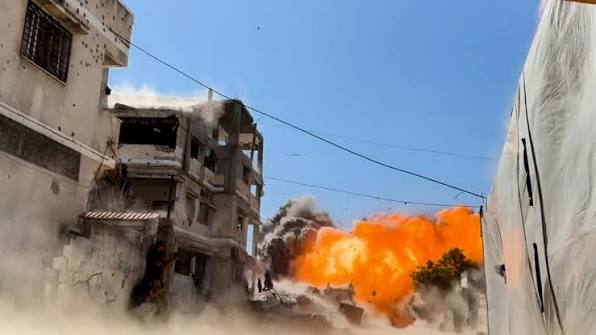
As strikes throughout the Middle East overshadowed diplomatic efforts in Pakistan to preserve a temporary ceasefire agreement that has crumbled, missile alert sirens blasted in Jordan’s coastal city of Aqaba on Wednesday. “Air defence systems today detected six missiles coming from Iranian territory, the Jordan army said in a statement, adding that they “intercepted and downed four missiles, while the other two fell in two remote, uninhabited areas, without causing any human casualties or material damage”.
Videos taken by residents of the nearby Israeli city of Eilat showed plumes of smoke rising above Aqaba. Earlier on Wednesday, the US military announced that it had finished its eleventh night of attacks on Iran. Iran’s state-run IRNA news agency said that explosions rocked the provinces of Bushehr, East Azerbaijan, Hamadan, Hormozgan, Khuzestan, and Sistan and Baluchistan. Iranian air defences were deployed in the vicinity of Tehran. The US said that drone storage facilities and aircraft hangars were among its targets.
That followed Iran’s attack on a tanker in the strait on Tuesday, which resulted in the crew having to flee the vessel. Iran continued to assault US partners in the area as well. Additionally, Iran attacked Kuwait, Bahrain, and Jordan. In an attempt to revive diplomacy, Iranian Interior Minister Eskandar Momeni travelled to Pakistan, a crucial conflict mediator, prior to the most recent strikes. However, it was unclear what fresh agreement might be achieved to put an end to the conflict, which has recently turned into a struggle over control of the Strait of Hormuz, a waterway essential to global energy supply.
Speaking from the Oval Office on Tuesday, Trump expressed a pessimistic outlook on potential negotiations, stating that the US has “no interest in meeting.” He hinted that a region of Iran near one of the country’s primary nuclear enrichment facilities would soon be targeted by US forces. The day before, the Houthi rebels in Yemen, who are supported by Iran, declared a naval blockade of Saudi Arabia, opening a new front against the country and endangering international trade and oil supplies. Saudi Arabia has been depending on a pipeline to the Red Sea to deliver millions of barrels of oil to the market due to the closure of the Strait of Hormuz.
Also Read:
For The Ninth Day, The US Strikes Iran
Meet Talex Maxim: Building Behavioral Intelligence for the Next Generation of AI
About Author