
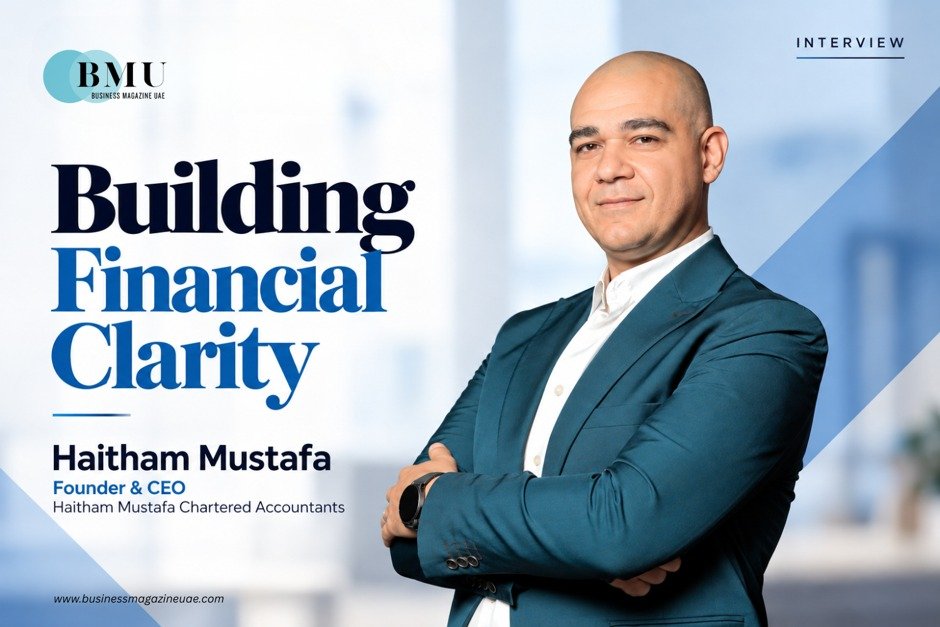
For many businesses, having financial records is only the beginning. Understanding what the figures mean, meeting reporting requirements, and using financial information to plan for growth matter just as much. With more than 17 years of experience in accounting and auditing, Haitham Mustafa has built his work around helping businesses see their finances more clearly.
As Founder and CEO of Haitham Mustafa Chartered Accountants, he works with businesses across sectors on financial reporting, audit, tax, and advisory services. His approach pairs professional standards with cloud accounting systems and AI tools. In this interview, Mustafa explains why he started his firm, the reporting challenges his clients face, where AI fits into accounting, and what companies can do to strengthen their financial practices.
Why Haitham Mustafa Built a Firm Around Financial Clarity
We began by asking what led Mustafa to set up his own accounting and advisory firm after years in the profession.
“What inspired you to establish Haitham Mustafa Chartered Accountants?”
Mustafa explained, “After more than seventeen years as a Chartered Accountant and advisor, I saw that many businesses had figures but not the financial clarity to build on them. I set up the firm to be a partner in their success, not an office that hands over schedules at year end. We work from planning and compliance through to the report that opens the door to financing and expansion. Our principle is simple: full transparency, precise execution, and respect for local regulations and international standards. From Egypt, we serve clients across many sectors, because the challenge is the same everywhere. Banks, authorities, and owners all need statements they can trust. The firm is now in a measured phase of expansion. We are working to open a branch in Hurghada, closer to the Red Sea market, so clients in tourism, investment, and real estate have a partner who understands their business. Next, we plan to go international through a professional partnership with a foreign firm that shares our standards and can support clients operating across more than one market.”
How the Firm Helps Businesses Prepare for Audit and Reporting
Each industry brings its own reporting demands. We asked how the firm helps clients meet them and produce statements they can rely on.
“What are the main financial reporting and audit challenges you help clients overcome?”
He shared, “We serve contracting, manufacturing, retail, healthcare, hospitality, and real estate, among other sectors. Each has its own operating language, and the financial problem keeps returning in a different form: long-term contracts in contracting, inventory valuation in manufacturing, e-invoicing in retail, the revenue cycle in healthcare. We help clients with three things. First, books that are ready for audit from the outset, not at the last moment. Second, a report prepared under the right framework, whether Egyptian standards or International Financial Reporting Standards. Third, an audit file built on an independent review of internal control and material misstatement, so the report can stand before the bank, the tax authority, and stakeholders. Our approach has three steps: understanding the business and assessing risk, fieldwork and digital procedures, and a report discussed with management along with practical recommendations.”
Where AI Fits into the Accountant’s Work
Cloud accounting and artificial intelligence are changing how financial information is recorded, reviewed, and reported. We asked Mustafa how his firm uses these tools while protecting accuracy and confidentiality.
“How do you integrate artificial intelligence and tools such as Xero and QuickBooks?”
Mustafa said, “Technology is part of how the firm works, not a cosmetic addition. For each client, we build a digital accounting structure that suits the size of the business: a chart of accounts, a document cycle, and a system such as Xero, QuickBooks, Odoo, or a full enterprise resource planning platform, depending on the activity. Transactions are recorded daily, bank accounts are reconciled regularly, and periodic reports go out on time. Inside the firm, we want our own tools to keep developing, and we are about to release a program built for our daily work. Its purpose is to save a significant amount of time while leaving no room for oversight. Artificial intelligence remains an assistant for extraction, matching, and first review. Professional judgment, and responsibility for the opinion, stay with the accountant. Client data is protected by encryption and access controls, because speed means nothing if control of the file is lost.”
Why a Figure Should Never Arrive Without Analysis
Accounting reports are most useful when business owners can understand the results and act on them. We asked what clients can expect from the firm’s approach to service and analysis.
“What sets the firm apart in client service and financial analysis?”
He explained, “The client gets a single team covering audit and assurance, tax planning, bookkeeping, advisory, company formation, and electronic payment solutions. What sets us apart is that a figure never arrives on its own. We connect it to analysis an owner or board can use: margins, cash flow, performance against sector indicators, and what changed between periods and why. The independent report remains the mark of credibility, and the analysis turns it into a decision. We stay transparent at every stage, because trust grows when clients can trace the result, not just receive it.”
Advice for Businesses That Want Fewer Surprises
For our final question, we asked what businesses can do to strengthen their reporting and compliance before problems appear.
“What advice would you give businesses seeking to strengthen their reporting and compliance?”
Mustafa advised, “Don’t wait for an external examination to be the first time the figures are reviewed. Close the books every month. Reconcile the bank, receivables, payables, and inventory as you go, and write the policies for revenue, contracts, and estimates before they are required in the notes. Choose one accounting system that fits the size of the business, stay with it, and stop keeping a parallel set of figures that nobody owns. If the report will go to more than one party, or under more than one framework, reconcile the accounting differences from the start of the year. Keep the supporting document with the figure. Orderly books and internal control cost a business less than a penalty, an arbitrary tax assessment, or a report a bank will not accept.”
Good Records Come First
Throughout the conversation, Mustafa returned to the value of accurate reporting, clear processes, and sound professional judgment. For him, accounting is not only about recording what has happened. It is about giving owners reliable information they can use to understand their position, meet their obligations, and plan their next steps.
LinkedIn | Website | Haitham Mustafa Chartered Accountants
Also Read:-
Fashion That Speaks: Oluwabiyi Olusoga’s Vision
Creativity, Technology & Impact: The Digiwits Journey With Marc Bou Sleiman
About Author