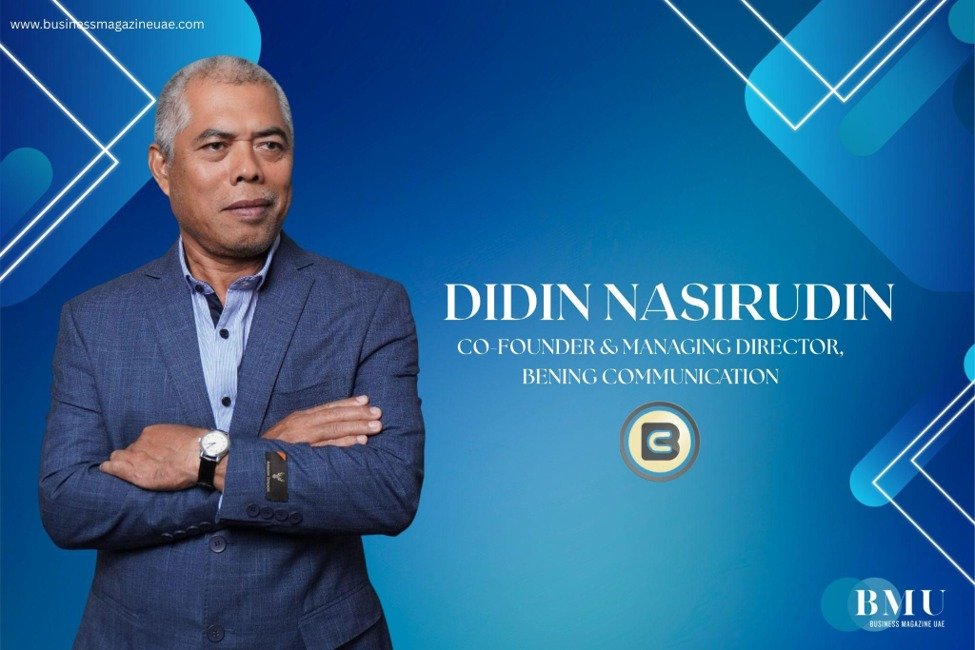
We recently had the opportunity to speak with Didin Nasirudin, Co-Founder and Managing Director of Bening Communication. His professional journey has taken him from nuclear engineering and management to journalism and public relations.
Today, Didin works across strategic communications, reputation management, government and stakeholder relations, crisis and issue management, and digital communications. His academic work in political communication and diplomacy has also broadened his perspective on politics, policy, and geopolitics.
We spoke with Didin about his unconventional career journey, the evolution of Bening Communication, the changing communications industry, the role of technology and AI, and the lessons he has gained along the way.
The Beginning
We started the interview by asking Didin about his career journey and how he eventually moved from nuclear engineering into communications.
“Could you start by telling us about your journey and work?”
Didin shared, “My professional journey has been quite unconventional. I graduated in Nuclear Engineering from Gadjah Mada University because, from a young age, I was fascinated by science, atoms, nuclear technology, and quantum physics. My original ambition was to work at a nuclear power plant that the Indonesian government was planning to develop. When that project did not materialize, I had to rethink my future and move into the private sector.
At different points, I worked as a lecturer and managed a branch of an English-language course, and became a journalist. Eventually, at the end of 1999, I entered public relations.
Nuclear engineering taught me structured thinking and how to simplify complex issues. Journalism taught me how the media works and how to identify what makes a story relevant. Public relations taught me how organizations build trust, manage perceptions, communicate strategically, and engage multiple stakeholders whose interests do not always align.”
Evolution of Bening Communication
We then asked Didin how his company has changed as the communications industry has evolved.
“How has your company/work evolved since you started?”
He explained, “I have always described Bening as a malleable organization. By that I mean we should never assume that the way we operate today will necessarily be the way we operate tomorrow.
Bening initially developed a particularly strong reputation in technology PR and has worked with more than 150 local and international brands. Today, we combine Traditional PR with Content Development, Event Management, Strategic Media Collaborations, Digital Marketing, Social Media Management, KOL and Influencer Engagement, Community Engagement, Government Relations, and Crisis and Issue Management.
We have also placed greater emphasis on data, monitoring, and research, including real-time news and social media monitoring, newsroom analysis, SEO, and GEO.
So Bening’s evolution has not simply been about adding more services. It has been about moving from media relations to integrated reputation management, public affairs, strategic intelligence, and executive-level counsel.”
The Wider Role of Communication
Interested in understanding how Didin sees communications contributing to the wider business ecosystem, we asked him about the role his work plays in the region.
“How does your work contribute to the ecosystem in your region?”
Didin stated, “The first contribution is building trust between organizations and their stakeholders. A company may have an excellent product, technology, or business model, but if it cannot clearly explain its value, establish credibility, or respond effectively when problems arise, its ability to grow will be limited.
These relationships are not simply contacts; more importantly, they improve my understanding of how different actors think, what concerns them, how they interpret public issues, and how policy debates evolve.
For C-level executives and investors, communications advice alone may therefore be insufficient. They sometimes need help interpreting the wider environment.”
Qualities for Success
We next asked Didin which qualities he believes professionals need to develop lasting careers in the communications industry.
“What three qualities do you believe are critical for success in your industry?”
He shared, “If I had to choose only three, adaptability, resilience, and trustworthiness.
Adaptability, however, does not mean chasing every trend. It means understanding which changes are structural and which are temporary.
A crisis can force you to become more efficient, more flexible, or more creative.
PR, government relations, lobbying, political consulting, and executive counsel all depend on credibility.”
Technology and AI
With artificial intelligence becoming increasingly important across industries, we asked Didin about the technological changes he is seeing in the business world.
“What are your views on the current technological advancements in the business world?”
Didin explained, “Artificial intelligence, in particular, will profoundly change the way businesses operate.
For a communications business such as ours, this means technology is no longer simply a tool that supports PR. It is becoming part of the communications environment itself.
My approach is not humans versus AI but humans working with AI.”
He also sees AI supporting areas such as media monitoring, social listening, research, content development, and analysis, while human qualities such as trust, empathy, creativity, ethical judgment, leadership, and relationships remain important.
Lessons from the Journey
Finally, we asked Didin what advice he would offer someone trying to establish themselves in the communications industry.
“How would you guide someone to navigate the key challenges you faced when establishing yourself in this industry?”
Didin reflected, “The first thing I would tell them is: do not expect a straight career path. Mine certainly was not.
Learn by doing, but never stop upgrading yourself.
Build relationships before you urgently need them.
Protect your reputation with the same seriousness you protect your revenue.
No one should die for business.”
Looking back at his own journey, Didin also recognises the value of the unexpected turns in his professional life.
“My own career shows that the destination can be very different from the original plan. I began by wanting to work in nuclear technology and eventually found myself advising companies, engaging with political and policy stakeholders, studying political communication, and analyzing U.S. politics and geopolitics. Sometimes the unexpected path is exactly where your most distinctive value is created.”
Connect with Didin Nasirudin on LinkedIn to learn more about his work in strategic communications, stakeholder relations, political communication, and geopolitical analysis.
Also Read:-
Creating Visuals That Speak: Mahmoud El Sabbagh
Parth Das, The Most Impactful Leader In The Video Gaming Industry
About Author