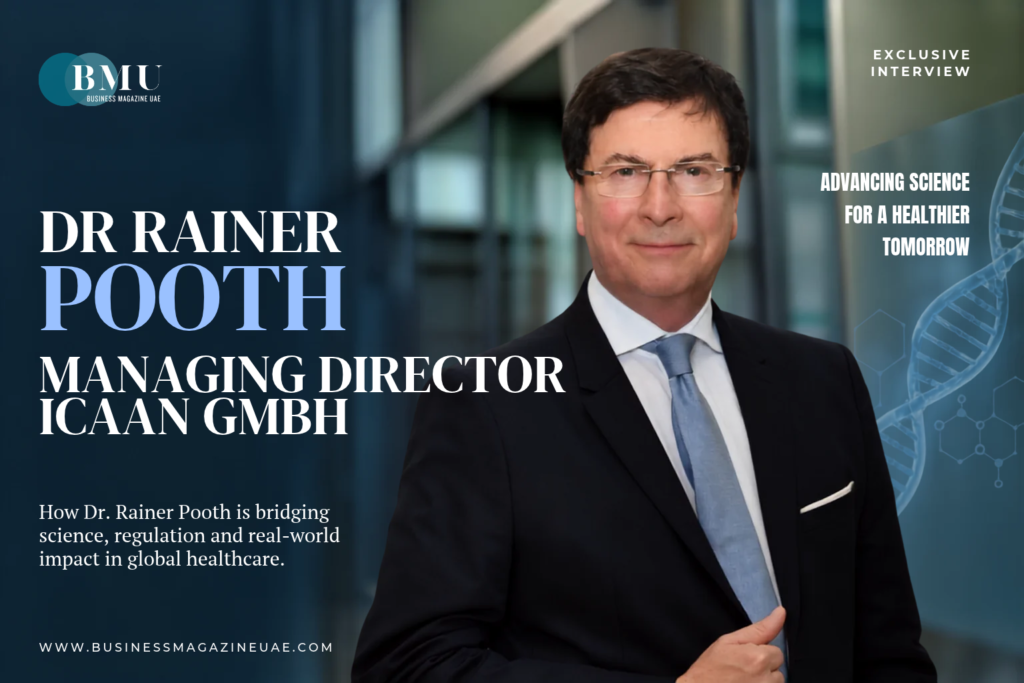
Dr. Rainer Pooth, based in Frankfurt, is a pioneer and inventor whose career spans more than 25 years across pharmaceuticals and medical devices, with experience covering the full development value chain. With a particular focus on aesthetic medicine, he has translated scientific concepts into products and solutions that can be developed, validated, approved, manufactured, and brought into clinical use.
His career has encompassed pharmaceuticals, biotechnology, medical devices, dermatology, clinical development, regulatory affairs, medical affairs and business development. He has led global development programmes, worked with international regulatory authorities, managed cross-functional teams, and guided products from research into commercial use. He has also built an extensive international network of experts and key opinion leaders in aesthetic medicine, developing and directing expert summits and advisory boards. Today, as Co-Founder and CEO of ICA Aesthetic Navigation GmbH (ICAAN), his work includes AI-enabled dermatology, aesthetic medicine and reconstructive surgery, alongside strategic advisory work for healthcare companies.
As Dr. Pooth has described it, his work in aesthetic medicine has increasingly focused on digital transformation and AI-driven, objective facial assessment. Through ICAAN, he has developed patent-protected software intended to support greater confidence and trust between patients and practitioners through data-driven treatment, while taking individuality, demographic factors, and diversity into account. He states that the technology has been tested across almost all ethnicities, age groups, and genders with a global network of experts. European MDR certification is in progress, and the company is interested in partners and strategic investors in the UAE and wider MENA region.
There is a practical quality to that career. Dr. Pooth has rarely occupied only one side of the table. He has had to consider the science, clinical evidence, regulatory pathway, manufacturing requirements, and commercial reality together. A promising molecule or device is only the beginning.
“After more than two decades in development, I have learned that a good scientific idea is only the starting point,” he stated. You have to ask what the clinical need is, what evidence is required, what the regulatory pathway looks like, and whether the product can ultimately be manufactured and brought to market. These questions cannot be considered separately. They have to come together early in the development process.”
The Long Road from Research to Reality
Dr. Pooth’s experience covers almost every major stage of the development process. His executive background includes R&D, product development, regulatory affairs, quality management, pharmacovigilance, medical affairs, and business development, with experience across drugs, biologics, medical devices, OTC products, and combination products. His regulatory work has included major markets and authorities such as the FDA, EMA, MHRA, PMDA, and TGA.
That breadth matters because development rarely proceeds in a straight line. Clinical results can change the course of a programme, regulatory requirements can alter timelines, and manufacturing issues can force decisions that were not obvious at the research stage. Commercial considerations can also determine whether an otherwise promising product fits a wider portfolio.
As CEO of ICAAN, he now leads his executive team on these questions. His current responsibilities include clinical development pathways, regulatory planning, market access, due diligence, technology evaluation and portfolio optimisation.
Asked how he decides whether a technology is worth pursuing, he replied: “I start with the problem. Is there a genuine medical or clinical need, and does the technology offer something meaningful in response to it? Then I look at the evidence, the development requirements, and the regulatory situation. I also consider the practical side. Can it be developed? Can it be manufactured? Is there a realistic route to market? Scientific novelty by itself is not enough. You need to understand the entire path.”
A Decade Inside Global Dermatology R&D
At Sanofi Aventis, Dr. Pooth worked in clinical R&D and was part of the Global Leadership Team for Dermatology. His responsibilities included global portfolio, development and licensing strategy, clinical development, quality, pharmacovigilance and project management, as well as the evaluation of licensing, cooperation and investment opportunities.
In 2005, he moved to Merz as Global Head R&D Dermatology, a role he held until 2015. He oversaw international product development involving drugs, medical devices and OTC products, including clinical programmes, regulatory submissions, manufacturing readiness, external CRO and CDMO relationships, quality compliance and lifecycle management. His work covered Europe, the United States, Asia-Pacific and Latin America, where requirements differed, but the need for robust evidence remained constant.
From 2015 to 2019, as Global Head of Scientific & Medical Affairs at Merz, he moved closer to medical and scientific strategy. He established global and regional strategies in aesthetic and medical dermatology, OTC products, and cosmeceuticals, while leading global KOL activities and international expert meetings. One notable milestone during his leadership was the development of one of the first botulinum toxin products to reach the market.
For someone who has spent so much time in dermatology, the attraction of the field is clear. It sits at the intersection of biology, medicine and visible outcomes.
“Dermatology has always interested me because there is a very direct connection between science and what patients experience,” he explained. “But what we see on the surface is only part of the picture. There are biological processes underneath that require careful scientific understanding. This is why I think better measurement, better evidence and better assessment can make a real difference, particularly in areas where outcomes are often evaluated visually.”
When the Face Becomes Data
Aesthetic medicine has traditionally depended heavily on clinical observation. A physician studies the patient’s face, listens to what the patient wants, and applies professional judgement. Technology is beginning to add another layer.
Dr. Pooth’s current work includes the development and validation of aesthetic scales for Asian and Caucasian faces, as well as work connected with AI-enabled dermatology and aesthetic medicine.
The distinction between measurement and judgement is central. An algorithm can identify patterns or quantify certain characteristics; it does not automatically understand the patient sitting in front of the physician. Dr. Pooth has therefore described AI as complementary to clinical expertise rather than a replacement for it.
“AI can provide additional information, but the clinician remains essential,” he said. “There are things that technology can measure more consistently than the human eye, and that can be useful. It can help make certain observations more objective, support clinical decision-making, and improve communication with patients. But an algorithm should not be treated as the final decision-maker. The clinical context matters, and every patient is different.”
For Dr. Pooth, the central question is less how much technology can do than where it genuinely adds value.
The Human Problem Inside a Technical Job
There is another side to senior scientific leadership that does not appear in a regulatory submission: people have to work together.
Dr. Pooth has spent years managing international and multidisciplinary organisations in which R&D, clinical, regulatory, quality, medical and commercial teams must reach decisions together. At Merz, he was responsible for aligning clinical, regulatory and marketing activities and served on senior corporate bodies including the Project Review Committee, Innovation Unit and R&D Leadership Team.
That kind of role can create friction. Scientific teams may want more evidence, commercial teams may want a faster route forward, and regulatory teams focus on what can be supported. None of these perspectives can simply be ignored.
“Clarity is very important,” he stated. “People need to understand what the objective is and what their responsibility is. At the same time, you need different perspectives around the table. I do not believe that one function can make all of the important decisions in a complex development programme. You need scientific expertise, clinical understanding, regulatory knowledge and commercial thinking. The challenge is getting those people to work toward the same objective.”
His executive profile reflects that cross-functional approach, highlighting experience building international organisations and aligning science, regulatory compliance, quality and commercial strategy. There is little room for silo thinking when a product must ultimately satisfy all of those disciplines.
From Big Organisations to Independent Advisory Work
Dr. Pooth’s current professional chapter differs from his years inside large pharmaceutical organisations. Since 2017, he has also worked independently as a consultant, advising on dermatology, aesthetic medicine, regulatory strategy, medical communications and KOL management. Since 2019, he has served as Managing Director and CEO of ICAAN GmbH, whose focus includes innovative MedTech in dermatology, aesthetic medicine and reconstructive plastic surgery. This work has led to the development and market launch of Caarisma MED, an AI-based full-facial assessment solution designed to provide objective and individual treatment recommendations while taking gender, age and ethnic background into account. Caarisma MED is the company’s flagship product for aesthetic medicine, and readers can learn more about the platform and request a demonstration through its official website, caarisma-med.com.
The change gives him a wider view of the market. Instead of being responsible for one company’s development portfolio, he can assess different technologies, business models and opportunities from the outside. He conducts due diligence and technology evaluations for industry and venture partners and advises clients on corporate strategy and portfolio decisions.
There is a different kind of responsibility in advisory work. A recommendation may influence an investment, a development programme or the direction of a company.
“When you advise a company, you have to be objective,” he explained. “You may see an interesting technology, but that does not mean you should automatically recommend moving forward. You have to look at the evidence, the risks, the development requirements and the commercial situation. Sometimes the right decision is to continue. Sometimes it is to change the strategy or not proceed at all.”
That willingness to stop and reassess is particularly relevant in healthcare, where development can consume years and substantial resources before a product reaches the market.
What Thirty Years of Change Has Not Changed
The tools have changed considerably since Dr. Pooth began working in clinical development. The regulatory environment has evolved, medical devices have become more sophisticated, data has taken on a larger role in development and assessment, and AI now sits much closer to everyday conversations about medical innovation.
Yet the basic questions remain: Does it work? Is it safe? Can the evidence support its use? Can it be developed responsibly? And does it solve a problem worth solving?
His career reflects that continuity. He has contributed to more than 120 peer-reviewed publications and approximately 40 patents, with multiple commercialised products and successful global approvals across Europe, the United States, Australia and Asia.
Looking back, he offers younger professionals entering pharmaceutical R&D, medical technology or aesthetic medicine a straightforward message: “Learn the science, but do not stop there. Try to understand how the whole development process works. Understand clinical development, regulatory requirements, quality, and the commercial side. You do not need to become an expert in everything, but you should understand how the different parts connect. And stay curious. Healthcare changes continuously, so you have to keep learning.”
It is a concise description of a career that has moved from medicine and pharmacy into biochemistry and pharmacology, then into clinical development, global dermatology R&D, scientific and medical affairs, consulting and, more recently, medical technology and AI-supported applications. He holds a doctorate in Biochemistry and Medicine, with a focus on Pharmacology, from Goethe University Frankfurt and studied Medicine and Pharmacy at Philipps University Marburg and Goethe University Frankfurt.
Now working from Frankfurt and across an international healthcare landscape, Dr. Pooth continues to operate in the space between scientific possibility and practical decision-making. That space is rarely simple—and perhaps that is precisely why experience matters.
Also Read:-
From Corporate Leadership To The Mahjong Table: Hashmat Pereira On Building Mahjong Success In Dubai
Alexandros Kapetanakis: EBS Consulting & Defence Innovation
About Author