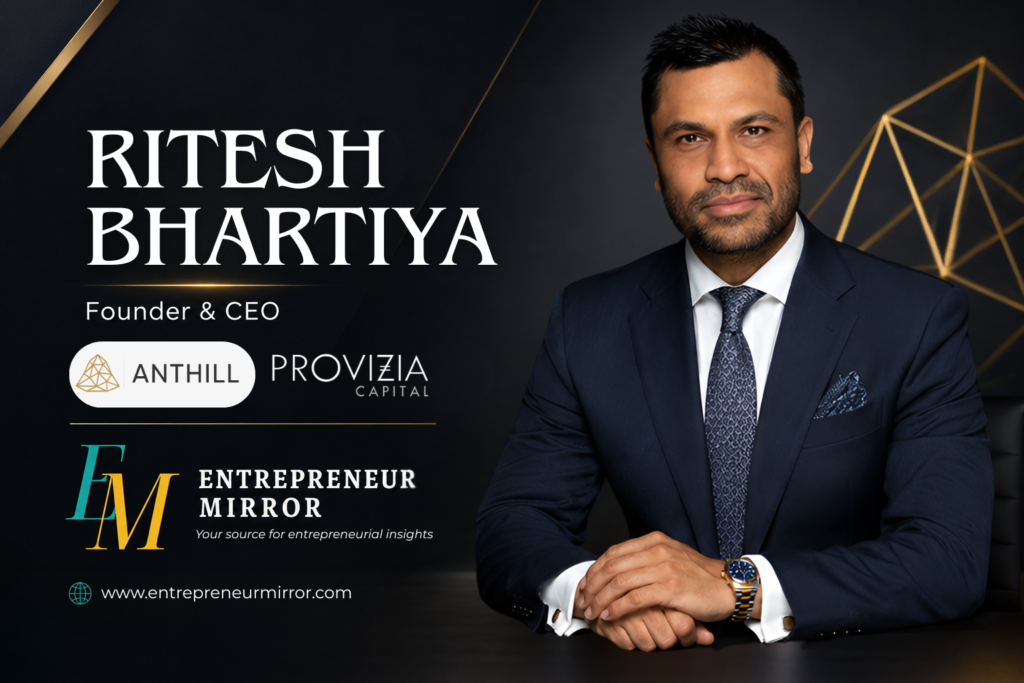
We recently had the opportunity to speak with Ritesh Bhartiya, founder and CEO of Provizia Capital, and Antihill P2P. After spending nearly two decades working with SMEs and closely noticing them, Ritesh realized how the entire ecosystem suffered from a prominent problem: the lack of capital at the right time. With creative solutions to address this challenge, he built his brands, where he empowers SMEs through expert advisory services and quick access to capital. Additionally, Ritesh Bhartiya serves as a Member of the Entrepreneurs’ Organization, sharing his insights with the industry.
Spark Behind the Journey
Entrepreneur Mirror: Your career spans some of the most respected names in the global and regional investment banking and advisory industry— Merrill Lynch, Ernst & Young, KPMG, and Alpen Capital, a GCC-focused debt advisory firm. That’s a trajectory most finance professionals spend a lifetime chasing. What made you step away from that path and back yourself as a founder?
Ritesh Bhartiya: “Honestly, entrepreneurship was never the plan. For most of my career, I assumed I would retire as a career investment banker — working my way up through institutions, building a reputation, and eventually landing at a senior role in a regional or global bank. That was the path I had mapped out for myself.
The turning point came during my time at Alpen Capital, where I spent more than six years. It was a well-regarded regional debt advisory house, and it was there that I was first exposed to debt advisory as a business — a discipline that would prove foundational to everything I built later. But over time, I found myself increasingly frustrated. I felt my contribution and capabilities were being undervalued, and that the firm’s culture rewarded execution over leadership. They wanted hardworking soldiers. I wanted to lead. That disconnect became impossible to ignore.
So I made the decision to put myself first — even if it meant failing. I left without a concrete plan, which in hindsight was either brave or reckless, probably both. What I did have was an opportunity: my brother and his partners had set up a DIFC-based firm focused on offering jumbo insurance policies for high-net-worth individuals, and they were missing an advisory capability. I joined them to set up the advisory business within their firm. It wasn’t a grand entrepreneurial vision — it was a calculated step toward doing things on my own terms. But that step changed everything.”
Bridging the Market Gap
Entrepreneur Mirror: When you founded Provizia Capital, you were stepping into a market with no shortage of advisory firms. What was the gap you saw, and why were you confident you could fill it?
Ritesh Bhartiya: “Provizia Capital wasn’t conceived as a grand plan. It was born out of circumstance.
When my brother and I had a fallout with our partners at Que Capital, we both went our separate ways. I set up Provizia Capital in the UAE to offer debt and equity advisory services to my network of clients across the region.
I won’t pretend I was ready. I was neither mentally nor financially prepared. I started out of my garage, taking smaller engagements to keep the lights on while targeting larger mandates. From 2015 to 2017, it was a genuine struggle — no differentiated proposition, no master plan. Just backing myself with the skills I had.
The breakthrough came in 2017 when we closed a mezzanine debt deal for a client in Saudi Arabia, by arranging US$ 32 million in mezzanine debt from a leading regional alternative financing firm. It proved I could originate, execute, and close highly complex, high-value transactions entirely on my own.
What followed was an unconscious shift — a natural byproduct of the circumstances and experience accumulated over those years — with a clear focus on debt advisory, building a strong network of capital providers, and establishing a reputation as a seasoned alternative financing adviser.
COVID-19 wiped out eighteen months of work. Activity only started to resume from Q4 2021 — but when it did, I came out the other side a much stronger and more resilient professional and entrepreneur.”
Shaping the Next Era of Business
Entrepreneur Mirror: Most founders would stop at building one successful business. You went further and launched Anthill P2P — a direct capital deployment platform. What drove that second leap, and how different was it from founding Provizia?
Ritesh Bhartiya: “Like everything else in my journey, Anthill was never planned. It emerged from two parallel realisations that converged at the same time.
The first was external. As I spent more time working with SMEs — not just as a deal-driven adviser but as a trusted, in-house problem solver — a very specific gap became impossible to ignore. These businesses needed immediate bridging solutions, and no one was providing them fast enough. I kept asking myself: how could I be of genuine use to my clients beyond arranging banking or mezzanine debt?
The second realisation was internal — and equally important. As Provizia grew, I became increasingly aware of a fundamental limitation: the business was entirely dependent on me. If I stopped showing up tomorrow, it would grind to a halt. There was no legacy to speak of, no transferable assets, and no exit path. A people-dependent advisory business, however successful, is not a platform — it is a practice. And a practice dies with its practitioner.
At the same time, the world around me was being transformed by technology, and I had not meaningfully ventured into that space. I wanted to build something that combined my twenty-five years of SME financing experience with a technology backbone — something scalable, something with standalone value, and crucially, something I could monetize and exit. That is a motivation most founders are reluctant to admit, but it is a legitimate and important one. Anthill P2P was conceived out of that combination of market gap and personal ambition.
What started as a one-off pilot — matching pockets of liquidity amongst a few family offices I had built relationships with over time, and helping them deploy capital into short-term bridging solutions — has, since mid-2022, grown into a full-blown business.
Provizia was born out of necessity and circumstance. Anthill was born out of conviction — a deliberate response to both an external market gap and an internal need to build something lasting, scalable, and truly exitable. We are now in the final stages of establishing a fully regulated license and a tech platform, both active in the coming months — marking the next chapter in this journey.”
From Advisory to Accountability
Entrepreneur Mirror: As an adviser, your reputation is at stake. As a capital provider through Anthill, your money is too. How did that shift feel, and what does it demand of you as a decision-maker?
Ritesh Bhartiya: “It felt like a natural progression — but one that fundamentally changed my relationship with every decision I made. As an adviser, your emotional connection to an outcome only goes so far. You are committed, you are responsible, but you are ultimately financially disconnected. The moment I became a capital provider, that changed completely. The detachment disappeared and was replaced by a much deeper sense of commitment and accountability.
What it demands of me as a decision-maker is the ability to compartmentalise. I have to disengage emotionally from a deal depending on which hat I am wearing — adviser or capital provider — and act objectively and pragmatically in fulfilling my fiduciary obligations to either role. The moment emotion drives the decision, you compromise both.
In practice, this means routing clients to the right solution — not the convenient one. If a Provizia client has an immediate funding gap while a long-term solution is being structured, Anthill steps in with a bridging facility designed to be repaid by that liquidity event. If an Anthill client needs more than short-term capital, they are referred to Provizia for a proper long-term mandate.
The intent has always been to give clients the right solution — not just the immediate one.”
Driving Efficiency with AI
Entrepreneur Mirror: You’ve built firms that rely heavily on judgment, relationships, and speed. Where does technology — particularly AI — fit into that picture?
Ritesh Bhartiya: “Technology, and AI in particular, is an enabler — nothing more, nothing less. In our line of work, whether as an adviser or a capital provider, it can make us faster and more efficient. It cannot replace judgment.
In the financial services industry — and especially in the lending business — the best capital providers are not just analysts. They are intuitive decision-makers. Gut feeling and the ability to read a situation, a borrower, or an opportunity are as important as any credit model. That is not something a machine can replicate.
What AI has done for us practically is reduce the time spent on process-driven tasks — freeing us to focus on what actually matters: evaluating opportunities, structuring solutions, and making decisions. But when it comes to the final call, that rests heavily on experience, intuition, and the insights gained through direct interaction and assessment of every opportunity we encounter.
The machine processes. We decide.”

A Hand of Support in the Industry
Entrepreneur Mirror: You are a member of the Entrepreneurs’ Organization — a global community of founders and business owners. What has that membership meant to you, and how has it shaped your entrepreneurial journey?
Ritesh Bhartiya: “Joining the Entrepreneurs’ Organization was another turning point in my journey — one I did not anticipate but one that has proven deeply meaningful.
In my previous professional life, I knew entrepreneurs only as clients or through a handful of family connections. I was always adjacent to the entrepreneurial world — advising it, financing it — but I never truly felt I belonged within it. Becoming a member of EO changed that. For the first time, I found myself amongst a community of like-minded individuals who understood the challenges, the uncertainty, and the relentless demands of building something of your own.
What EO gave me was a sense of belonging — not the feeling of having arrived, but the quiet conviction that I belong to something larger than myself. A community of founders who face similar challenges, who are willing to share their experiences openly, and who genuinely want to help each other grow and succeed.
That is something no corporate career could ever offer. In the institutional world, you compete. In EO, you collaborate. And in a journey as isolating as entrepreneurship can sometimes feel, having a community that helps you enjoy the ride rather than get bogged down by its challenges is invaluable.”
Partnership or Building Solo: Ritesh Bhartiya’s Perspective
Entrepreneur Mirror: Provizia Capital appears to be very much a solo venture. Did you ever have partners along the way, and if so, why didn’t those partnerships last? What has been your biggest takeaway from the experience of building largely on your own?
Ritesh Bhartiya: “Like everything else in my entrepreneurial journey, partnerships were never planned — they emerged organically along the way. I did attempt to foster a few over the years, mostly working partnerships, but unfortunately, they did not last.
After my experience with several failed working partnerships, a pattern became clear. Partnerships are a valuable asset — but for them to work, two conditions have to be in place: First, the partners should bring complementary skills to the table, and second, each partner should be equally committed, both in terms of work and vision, to making it succeed. The moment one partner feels they are carrying more than their share, the foundation begins to crack.
Building a business alone is daunting. There is no one to share the weight, the uncertainty, or the sleepless nights. But I have come to believe that the wrong partner is far worse than no partner at all. A bad partnership doesn’t just slow you down — it can derail everything you have built.
My takeaway is simple: partnerships are a great asset, but only when measured against two non-negotiable criteria — complementary skills and unparalleled commitment. Anything short of that, and you are better off alone.”
Decisions that Shaped the Journey
Entrepreneur Mirror: If you could go back and choose again — corporate career or entrepreneurial path — which would you choose, and what does that answer tell you about the journey you have taken?
Ritesh Bhartiya: “If I had to choose again, I would make the same choice without a moment of hesitation.
Had I only imagined the pain, the pitfalls, and the lack of financial security this path brings, I would probably have thought twice. But having lived through two full cycles of severe downturns and come out successful on the other side both times, I would always choose this purposeful life over a cushy corporate job that, in most cases, comes without any real purpose.
Had I stayed in institutional finance, I would likely have reached a senior leadership position — financially rewarding and professionally respected. But that success would have lacked what this journey gave me — the clarity to identify a real problem, the courage to build a solution, and the resilience to see it through.
This choice means everything I stand for. It has given me purpose and a recognition I would never have commanded from behind a corporate title — and it gives me enormous pride and joy to know that what I have built is solving real problems for the most neglected segment in the business world.”
Connect with Ritesh Bhartiya on LinkedIn.
Find Provizia Capital on LinkedIn and visit their website to learn more.
Find Anthill P2P on LinkedIn and visit their website to learn more.
Also Read:-
Patrik Lazzarotto On The Future Of Relocation Consultancy: Trends, Challenges, And Opportunities
Priyanka Chandanani: Creating Lasting Learning Experiences With Logix Engine
About Author