
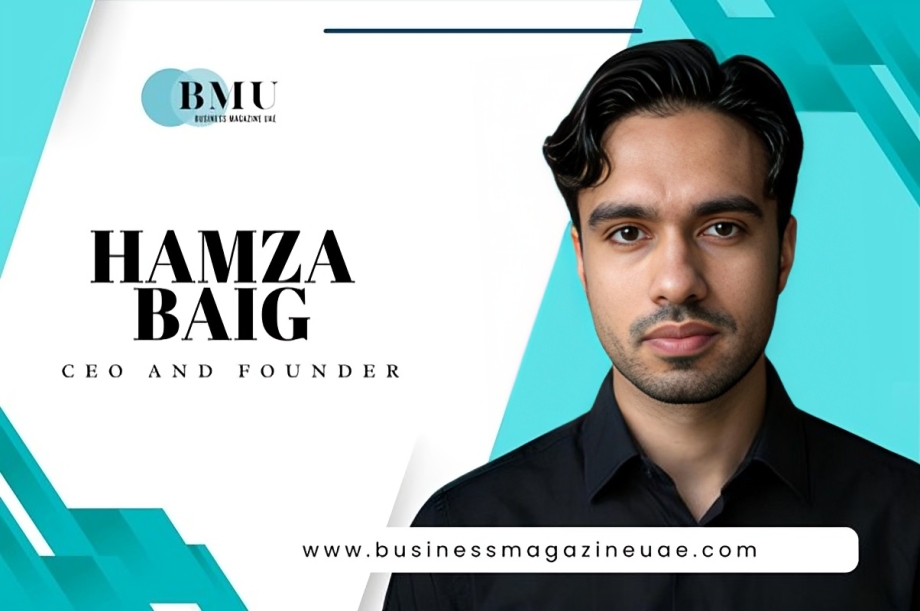
Very few leaders successfully adopt the power of AI to make a difference like Hamza Baig does. An entrepreneurial genius, he does not simply embrace tech trends. Rather, his motto is: “equal access to tech for all.” As an automation expert and educator, Hamza Baig has served over 1,500 satisfied clients to date, while training more than 45,000 students across the globe. With his passion and leadership, Hamza has become an important part of the automation revolution of the current time.
Spark Behind the Journey
We started the interview by asking, “Could you start by telling us about your professional journey and the inspiration behind jumping into this industry?”
Hamza Baig shared, “I have always been an entrepreneur at heart. Even before I had the language for it, I was always looking at problems and thinking about how to build something around them. I tried my hand at a few different ventures over the years, some worked, some didn’t, but every single one taught me something I ended up using later.
The real turning point came right after COVID. While the rest of the world was adjusting to lockdowns and remote work, I was paying close attention to what small research labs, particularly those tied to OpenAI, were quietly building. I remember reading about GPT-3 and thinking, this is not just another tech trend. This is going to reshape how businesses operate at every level. I felt it in my gut, the same way people in the late ’90s felt the internet was going to change everything.
So I started early. If you go back and look at my YouTube channel, you will find videos about AI and automation from before ChatGPT even launched publicly. I was not doing that because it was trendy. Nobody cared about AI back then. I was doing it because I wanted to be positioned when the wave hit. And when ChatGPT finally dropped, we were one of the first teams to take this technology and package it for businesses. While everyone else was using it to write essays or joke around, I was already thinking about how it could replace manual processes, act as a front-line salesperson, handle customer service, generate content at scale, and fundamentally give small businesses the capabilities that only large corporations could previously afford.
That early conviction was not easy to act on, though. Nobody trusted AI. Nobody understood it. Most business owners thought it was either a gimmick or something that would blow over. So I spent a lot of those early days doing free work, building proof-of-concept projects, educating people one conversation at a time, and grinding through rejection after rejection. There were no playbooks. There were no step-by-step tutorials. I had to figure everything out through trial and error, breaking things, testing things, rebuilding from scratch.
As the technology matured and AI became more mainstream, things started to shift. The agency gained real traction. And then something interesting happened. Other people started watching the moves I was making and wanted to learn how to do the same thing. That is when I transitioned from just building AI solutions to also teaching people how to build AI businesses. I launched programs, mentorships, and eventually The Automation Institute, because I wanted to create the resource I never had when I was starting out.
Today, I have helped over 45,000 people learn about AI and automation, and thousands of them have gone on to build profitable, successful businesses on the back of what they learned. That is what drives me. Not just building technology, but making it accessible to people who would never have had the opportunity otherwise.”
Lessons, Growth, and Beyond
We then asked, “As an expert in this field, what are a few lessons that helped you in leading your work?”
He added, “The first lesson is that speed beats perfection every single time. In the AI space, the technology changes so fast that if you wait for everything to be perfect before you launch, you have already lost. I have built systems and solutions where the first version was rough, no question about it. But getting it in front of real users and real businesses quickly taught me more in two weeks than six months of planning ever could. The feedback loop is everything.
The second lesson is that education is the most powerful sales tool you will ever have. Early on, I realized that trying to sell AI to a business owner who does not understand AI is a losing battle. But if you take the time to educate them, to show them what is actually possible, the sale takes care of itself. That philosophy shaped everything I do today, from how my agency operates to how I structure my courses. Lead with value, lead with education, and the business follows.
The third lesson, and this one took me longer to learn, is to protect your energy. When you are building something from the ground up, everything feels urgent. Every client request, every late-night Slack message, every fire that needs putting out. But not everything deserves your attention equally. I had to learn to prioritize ruthlessly, to say no to projects that were not aligned with where I was headed, even when the money looked good. The businesses and creators who last in this space are the ones who play the long game, not the ones who say yes to everything.”
Empowerment through AI: Navigating through Challenges
While challenges are an inevitable part of every industry, especially when it comes to tech, leaders like Hamza Baig have set exceptional examples in solving them. To learn more, we asked, “Would you like to share what you feel is a major challenge in starting a business or career? And how did you overcome it?”
Hamza Baig explained, “The biggest challenge I faced, and honestly still face in certain pockets, is convincing traditional businesses to trust AI. When I started, the general sentiment toward artificial intelligence was overwhelmingly negative. People were afraid. They thought AI was going to take their jobs, ruin their businesses, or worse. Hollywood did not help either. Decades of movies about rogue robots and machines taking over the world planted a deep fear in people that had nothing to do with reality, but it felt real to them.
On top of that, you had news headlines every other week screaming about how AI was going to replace entire industries. So when I walked into a room and told a business owner that I could build them an AI system to handle their customer calls or automate their sales follow-up, the default reaction was suspicion, not excitement.
Overcoming that required patience, a lot of it, and a willingness to do the work upfront without expecting anything in return. I ran free demos. I built proof-of-concept systems that I never charged for. I spent hours on calls just educating people on what AI actually is, what it can do, and more importantly, what it cannot do. I found that the moment you remove the mystery and give someone a real, tangible example of AI working in their specific business, the fear starts to dissolve. It was never about the technology being untrustworthy. It was about the lack of understanding.”
“The real breakthrough came when I shifted the conversation from ‘AI is going to replace you’ to ‘AI is going to empower you.’ That reframe changed everything. Once a business owner saw that AI was not there to eliminate their team but to make their team faster, sharper, and more efficient, the resistance dropped. They went from skeptics to advocates. And many of those early skeptics are now some of my strongest long-term clients,” he even mentioned.
Future Plans in the Pipeline
Intrigued to learn about the plans for the services that Hamza Baig provides, we requested him to share a bit about them with our viewers.
He reflects, “We are in a really exciting phase right now. On the agency side, through Hexona Systems, we are working with larger enterprise clients on complex AI deployments. I am talking about custom voice AI receptionists, full CRM automation builds, and integrations that connect multiple business systems into one intelligent workflow. We are not just dropping a chatbot on someone’s website and calling it a day. We are building AI infrastructure that becomes a core part of how a business operates. That level of depth and customization is where I believe the industry is heading, and we are already there.
On the education side, The Automation Institute continues to grow. We have over 45,000 students now, and the demand is only accelerating. I am expanding the curriculum to keep pace with how fast the tools and platforms are evolving. What I am most excited about is the community we have built around it. These are not passive learners. These are people who are actively launching agencies, landing clients, and building real businesses. I am also doing live workshops and bootcamps through another venture called Freedom By AI, where we bring people together for hands-on, intensive training sessions. The energy in those rooms is something else entirely.
Looking further ahead, I am developing SaaS products that bring AI capabilities directly into niche industries. The vision is to take everything I have learned from custom client work and productize it, so businesses that cannot afford a full custom build can still access powerful AI tools out of the box. That is the next frontier for us.”
AI behind Transformation
We further asked Hamza Baig, “Nowadays, as you would see, AI is everywhere, and businesses are increasingly adapting to it. What are your thoughts on this?”
Hamza Baig explained, “I have been saying this since before it was popular to say it: AI is not a trend, it is a transformation. What we are seeing right now with businesses adopting AI is still the very beginning. Most companies are only scratching the surface. They are using AI for content generation or basic chatbots, and that is fine as a starting point, but the real value lies in using AI to rethink entire workflows, decision-making processes, and customer experiences from the ground up.
What excites me is that AI is becoming the great equalizer. A solo entrepreneur with the right AI tools can now compete with companies that have fifty employees. A small roofing company in Utah can have an AI receptionist that handles calls, books appointments, and qualifies leads with the same professionalism as a Fortune 500 call center. That was not possible even two years ago. The barriers to entry for running a high-performing business are collapsing, and AI is the reason.
But I will also say this: businesses that adopt AI without understanding it are going to waste a lot of money. AI is not magic. It requires thoughtful implementation, proper training, and someone who understands both the technology and the business problem it is solving. That is where a lot of companies go wrong. They buy the tool but do not invest in the strategy.”
“My advice to any business leader reading this is simple. Do not just adopt AI because everyone else is doing it. Understand what problem you are solving, and then use AI as the tool to solve it better, faster, and at scale,” he added.
Insights of an Expert
Addressing the beginners in his field or in any field of business, we asked Hamza Baig to share a few words of wisdom.
“Start before you feel ready. That is the most honest advice I can give. When I started, I had no formal AI training, no playbook, no mentor handing me the answers. I had curiosity and a willingness to figure things out by doing. If I had waited until I felt ‘qualified,’ I would still be waiting.
The second thing I would say is: become an educator, not just a practitioner. The people who win in any industry are the ones who can take something complex and make it simple for others. When I started teaching AI to business owners and aspiring agency builders, it did not just help them. It sharpened my own understanding, built my reputation, and created opportunities that I never could have manufactured through traditional marketing. Authority is not given. It is earned by being the person who shows up consistently and adds value before asking for anything in return.
And finally, do not be afraid of the grind. There is a version of success that people see on social media where everything looks effortless. That is not real. The real version involves months of nobody caring, clients who ghost you, technology that breaks at the worst possible time, and moments where you genuinely question if any of it is going to work. Push through those moments. Every single successful person I know, including myself, has a story about a period where nothing was working and they kept going anyway. That persistence is not glamorous, but it is the difference between the people who make it and the people who almost did,” Hamza Baig shared.
Connect with Hamza Baig on LinkedIn, Instagram, X, and YouTube to gain industry insights.
Read more:
Alyona Zakharova: Behind the Scenes of a Fast-Moving Airline
Jacqueline O’Donovan OBE Championing Sustainability and Environmental Excellence
About Author