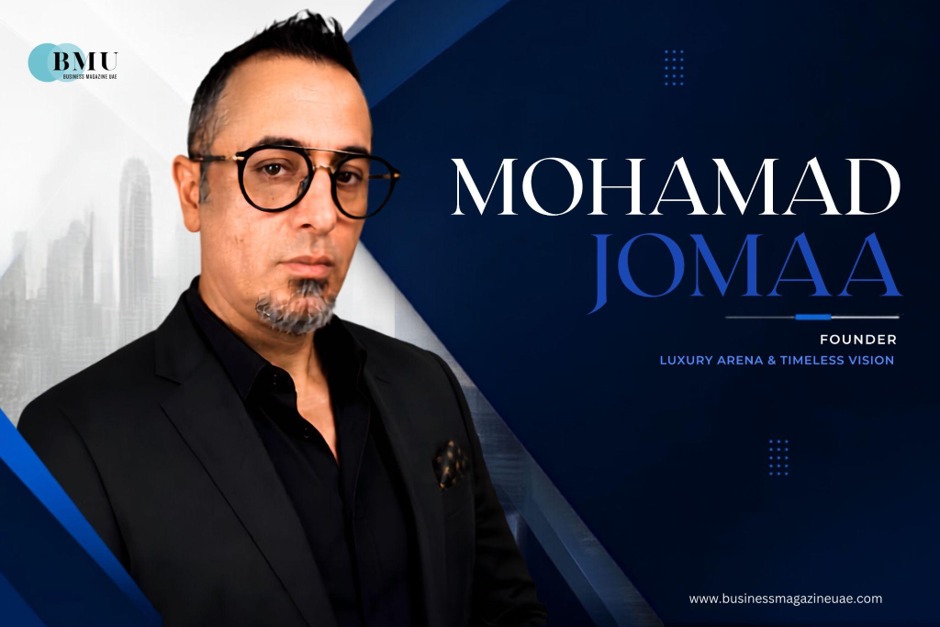
We recently had the opportunity to interview Mohamad Jomaa, an impactful entrepreneur with over two decades of experience in the eyewear, luxury retail, and distribution sectors. He leads as the Founder, Managing Director, and Managing Partner of multiple successful luxury ventures, including Luxury Arena, and Timeless Vision.
Parallel to these roles, Mohamad even offers his expertise as a Business Consultant for the Eyewear Division at JDM Swiss Group. Over the years, his skills in brand creation, market entry, and premium positioning have remained unmatched. With a strong belief in, “create the category, rather than fighting for space,” Mohamad Jomaa is shaping the future of this industry.
Spark Behind the Vision
We started the interview by asking, “What first inspired you to pursue your current industry or professional path? Was there a defining moment or influence that shaped your direction?”
Mohamad shared, “Honestly, luxury retail chose me before I chose it. I spent the early part of my career inside Paris Gallery Group, moving through finance, operations, logistics, and category management. That kind of 360° exposure is rare — most people in this industry see one side of the business. I got to see it all, from the invoice to the shop floor.
But the real turning point came with the Korloff Eyewear project. I spotted a gap in the market, worked with an Italian manufacturer, secured exclusive GCC distribution rights, and launched the brand. It became the top-performing brand at Paris Gallery very quickly. That moment changed how I saw myself — I wasn’t just running a business, I was building one.
And once I proved to myself it could be done, I couldn’t stop. I repeated the same playbook with Aigner Eyewear as a business consultant for JDM Swiss Group, and again with Momo Design Eyewear and Tonino Lamborghini Pens under Timeless Vision. Three different brands, three different categories — same discipline, same result. That’s when I knew this wasn’t luck. This was a repeatable model. And that’s what pushed me into founding my own ventures.”
Growth Amidst Challenges
Interested in learning about a significant challenge Mohamad Jomaa faced in his career or business, and how he successfully overcame it, we asked him to share the same.
He explained, “One of the toughest chapters was during my time at WGI Group, running the Chillibeans franchise. The brand had potential, but the business infrastructure wasn’t there — no proper systems, limited data visibility, and corporate sales were being handled reactively.
So I did what any operator with an investor mindset would do: I rebuilt the foundation. We implemented ERP and POS systems, restructured the category strategy, and turned corporate sales into a real pipeline — B2B, corporate gifting, institutional accounts.
But honestly, the technology was the easy part. The hard part was changing how people made decisions. Getting a team used to instinct-driven choices to trust data instead — that took patience, coaching, and a few visible wins before the culture shifted.
That experience gave me a lesson I carry into every venture today: you cannot scale what you cannot measure. It’s simple, but it’s the foundation of every business I touch now.”
The Future of Luxury
Every industry is going through rapid transformations. So, we asked Mohamad Jomaa, “What key trends or changes do you foresee shaping the future of your industry over the next 3–5 years?”
“The luxury landscape in the GCC is transforming faster than most people realize. Five things are on my radar:
First, luxury is going digital — properly digital. The GCC customer is young, sophisticated, and expects a seamless experience whether they’re in a boutique in Dubai Mall or shopping from their phone in Riyadh. A brand without a serious omnichannel presence will be invisible in five years.
Second, experiences are beating logos. People aren’t paying for a name anymore — they’re paying for story, craftsmanship, and personalization. That’s exactly why eyewear, watches, and writing instruments are having a moment. They’re personal. They’re expressive.
Third, the walls between wholesale, retail, and direct-to-consumer are collapsing. The brands that master all three will dominate.
Fourth, sustainability and provenance matter now. GCC consumers are asking real questions about where products come from — and they’re willing to pay a premium for the right answer.
And fifth, and this one is underrated, corporate gifting and B2B luxury are exploding across the region. Most operators aren’t paying attention to it. I am,” Mohamad mentioned.
Plans for Innovation and Impact
We then asked, “What are your long-term aspirations for your company or role, and what strategies are you implementing to reach them?”
Mohamad added, “My ambition is straightforward: I want Luxury Arena and Timeless Vision to become the reference platform for premium eyewear and writing instruments in the GCC. Not the biggest — the most disciplined, most profitable, and most brand-consistent group in the segment.
The strategy has four pillars. One, keep building the portfolio. Korloff, Aigner, Momo Design, and Tonino Lamborghini prove the model works. I’ll continue securing exclusive GCC rights with the right international partners — carefully, not greedily.
Two, omnichannel presence. Premium mall doors matter, but so do e-commerce, marketplaces, and digital storytelling. The customer decides where to buy, so I need to be everywhere they look.
Three, double down on corporate and institutional sales. It’s an underserved segment with strong margins, and it plays perfectly to my existing B2B network.
Four, run the business the way an investor would want it run — clean data, tight inventory, disciplined P&L, and EBITDA-focused decisions. Always investable, always scalable.”
Staying Ahead of the Curve
Technological advancements like AI are reshaping sectors, but the human element remains above all for a successful business. So, we asked Mohamad Jomaa, “How do you see artificial intelligence and emerging technologies influencing your industry or business model?”
“I think AI is going to quietly rewrite the economics of luxury retail, and the operators who lean in early will pull ahead significantly.
In my business, I see three places AI creates real value. First is inventory and demand forecasting. Luxury lives and dies on inventory turns. AI will let us predict what sells, where, and when, with a precision that traditional ERP just can’t match.
Secondly, personalization. Imagine a customer browsing eyewear online and getting recommendations based on their face shape, their previous purchases, and their style DNA. That used to require a talented salesperson in a boutique. Now it can happen at scale, 24/7.
Third is B2B intelligence. For corporate gifting and institutional sales, AI helps us identify the right accounts, the right timing, and the right product mix. That’s a game-changer for the wholesale side of my business.
But, and this is important: AI will never replace the soul of luxury. Craftsmanship, story, and human relationships are what make a brand truly premium.
My philosophy is simple: let AI handle the operations so my team can focus entirely on the client and the brand,” he stated.
Values Guiding Mohamad Jomaa Forward
To learn more, we asked Mohamad Jomaa to share the core values or guiding principles that influence his decisions and the way his organization operates with our viewers.
Mohamad mentioned, “Four principles guide everything I do. First is discipline over glamour. Luxury attracts a lot of noise. I stay focused on the numbers behind the sparkle — margins, turns, EBITDA.
Secondly, I prefer long-term partnerships over short-term wins. Whether it’s a manufacturer in Italy, a shareholder, or a mall operator, I build relationships meant to last decades, not quarters. The exclusive agreements behind Korloff, Aigner, Momo Design, and Tonino Lamborghini all came from that mindset.
Thirdly, brand equity is sacred. A luxury brand takes years to build and one bad decision can damage it. Every pricing decision, every channel choice, every partnership goes through one filter: does this protect the brand, or dilute it?
And lastly, an investor mindset — always. Even when I was managing a category, I acted like an owner. That’s the mindset I demand from every leader in my team today.”
Milestones in the Journey
Leaders like Mohamad Jomaa can turn every setback into a success. So, we asked, “Can you share an innovative strategy or approach that helped your company stand out or achieve a breakthrough?”
He reflected, “The breakthrough, and the one I’m most proud of — is what I now call the ‘category creation’ playbook.
Most retailers in this region import existing brands and compete on availability, price, and shelf space. I flipped that model.
With Korloff, a French luxury house famous for diamonds, I saw they had no eyewear line in the GCC, so I helped create one. Exclusive Italian manufacturing, exclusive regional distribution, positioned inside Paris Gallery’s premium doors. It became a top-ranked brand almost immediately.
Then I repeated it with Aigner Eyewear as a consultant for JDM Swiss Group — same principle, different brand: identify a house with strong equity but no presence in a specific category, build the product, control the distribution, execute the launch.
Then I did it again with Momo Design Eyewear and Tonino Lamborghini Pens under Timeless Vision, expanding from eyewear into writing instruments, but using the same disciplined approach.
Four brands. Three categories. One repeatable model. The lesson I keep coming back to: don’t fight for shelf space in a crowded category, create the category. That’s the foundation of everything I’m building now.”
Evolution of Mohamad Jomaa as a Leader
Lastly, we asked, “How has your leadership style evolved throughout your journey, and what lessons have shaped your approach to leading teams or businesses?”
“My leadership style has gone through three chapters. Early on, at Paris Gallery, I led through technical expertise. I knew the numbers, the logistics, and the operations, and I earned respect by outworking everyone in the room. That works, until it doesn’t scale.
In the middle years, at WGI, I evolved into a systems-driven leader. Two experiences really shaped this — the Management Development Programme in 2015 and Ron Kaufman’s Service Leader Workshop in 2016. That’s when I realized leadership isn’t about being the best operator in the room. It’s about building the environment where great operators can thrive without you having to be in the room.
Today, as a founder, my style is vision-driven and coaching-oriented. I set the direction, I demand high standards, and then I trust my team to execute. I’ve learned the hardest and most important lesson for any founder: hire people better than you in specific areas, and get out of their way.
Three lessons I’d pass on to anyone building a business:
You cannot scale what you cannot measure. Culture eats strategy — but strategy without culture is just a slide deck. And the best leaders build other leaders, not followers,” Mohamad responded.
Connect with Mohamad Jomaa on LinkedIn to gain industry insights.
Also Read:-
Patricia Aguilar’s Vision To Empower Small And Local Businesses
Eslam Helmy On Creating A Lasting Impact Through Visual Storytelling
About Author