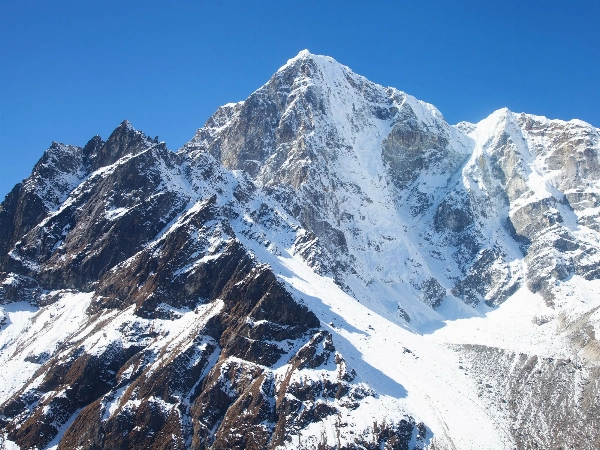
According to a research published this month, the Himalayas are nearing a tipping point as glaciers melt more quickly than they did ten years ago, endangering water security as the region hits “peak water” by mid-century. The results follow the late August collapse of a Himalayan glacier at the boundary between Nepal and Tibet, which resulted in flash floods and tumbling landslides in the lowlands below. Over 5,300 people are missing in Tibet and Nepal, and at least 1,300 people have been proven deceased.
The study discovered that when glaciers recede, they are leaving behind unstable glacial lakes above valleys where millions of people reside, held back by little more than loose rock and ice. According to Reuters, the Integrated Mountain Initiative, the International Center for Integrated Mountain Development, and India’s G.B. Pant National Institute of Himalayan Environment collaborated with sustainability advisory firm Systemiq to compile the study.
Only 21 of the estimated 40,000 glaciers in the Hindu Kush-Himalaya region—a massive mountain chain covering eight nations from Afghanistan to Myanmar—were now monitored on the ground, according to the study, which also revealed that the mass loss of Himalayan glaciers had increased in recent decades. 56 of India’s nearly 200 high-risk glacial lakes are categorised as “very high risk,” leaving millions of people downstream at risk.
Water security would be significantly impacted as the area approached “peak water,” the point at which river flows cease increasing and begin to decline. Hundreds of millions of people relied on the Himalayas as a vital component of India’s national economic infrastructure, which supported over 20% of the country’s GDP. The Himalayan region, which makes up around 18% of India’s land area, is responsible for about 35% of the nation’s natural disasters.
Also Read:
Global Village Confirms Season 31’s Start Date
Dubai Tourism Will Take Part in the 2026 Arabian Travel Market
About Author