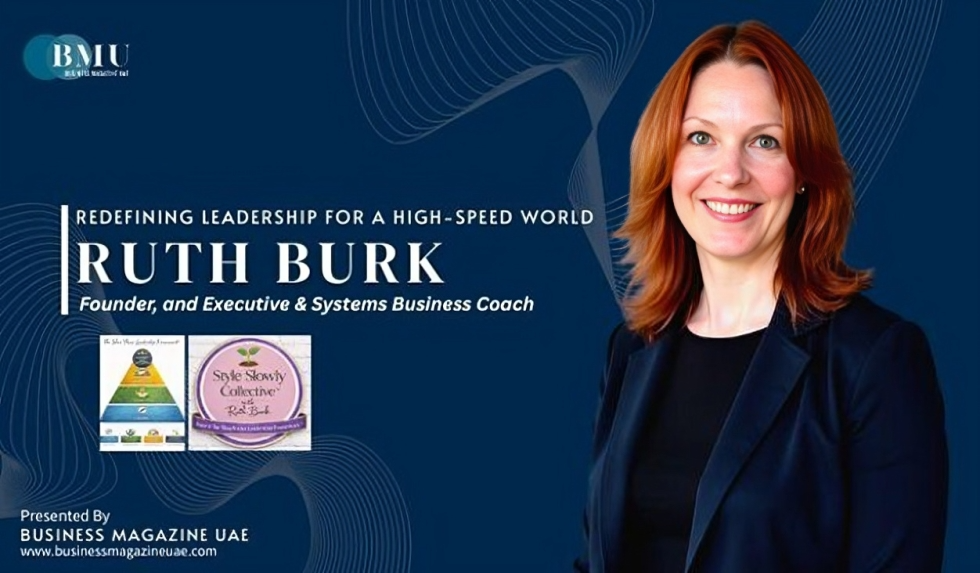
We recently spoke with Ruth Burk, Founder and Executive & Systems Business Coach at Style Slowly Collective, a platform reimagining leadership authority for women founders and senior leaders. Through her Slow Power Leadership Framework™, Ruth Burk focuses on strengthening the structure beneath leadership in the age of AI. With over 15 years of experience across law, technology, and entrepreneurship, she supports leaders navigating growth, responsibility, and increasing complexity.
The Spark Behind Her Journey
We began by asking what first inspired her to pursue her current path and whether there was a defining moment that shaped her direction. “What first inspired you to pursue your current industry or professional path? Was there a defining moment or influence that shaped your direction?”
Ruth Burk shared, “My path into leadership coaching was shaped less by a single moment and more by recurring experiences that revealed the same pattern.
Early in my career, I founded my own law practice, where every decision and outcome rested on my judgment. That experience made it clear that leadership is inseparable from consequence and that clarity under pressure is not optional.
As I moved into more complex operational roles across technology and real estate, I continued to see a consistent gap between strategy and execution. Organizations had capable leaders and strong plans, but alignment did not hold. Decisions were revisited, priorities competed, and momentum was difficult to sustain.
What shaped my direction was recognizing that the issue was not effort or capability. It was structure. Leaders were operating without systems designed to support judgment, alignment, and follow-through at scale.
That realization led me to develop the Slow Power Leadership Framework™, grounded in clarity, connection, and conscious momentum. My work now focuses on helping leaders ensure that as responsibility and visibility increase, their internal steadiness and decision-making clarity keep pace with their external demands.”
Navigating through Challenges
Challenges are a part of every business. To learn more, we asked Ruth Burk to describe a significant challenge she faced in her career or business and how she successfully overcame it.
She explained, “One of the most significant challenges I faced was starting my own law practice immediately after law school. I was responsible for every aspect of the business, legal strategy, client relationships, pricing, and outcomes. There was no separation between decision-making and consequence. Every choice had a direct and immediate impact.
What made this particularly challenging was navigating the gap between competence and perception, especially as a woman in an attorney role. Even when my work was strong, authority was not always assumed. It had to be established consistently through clarity, judgment, and follow-through. The way I overcame this was not by increasing effort, but by strengthening how I operated. I became disciplined in decision-making, clear in boundaries, and intentional about how I communicated value and authority.
That experience shaped how I lead today. It reinforced that leadership is built through consistency and structure, not external validation. It also laid the foundation for my later work across technology and operations, where I focused on bridging the gap between strategy and execution and helping teams move from reactive effort to sustainable momentum.”
Envisioning the Future
Ruth Burk is a reputed leader of her field. To gather her perspective on the potential industry trends, we asked, “What key trends or changes do you foresee shaping the future of your industry over the next 3–5 years?”
“The most significant shift shaping the leadership coaching industry is the increasing pressure on leaders as operational speed accelerates, particularly with the rise of AI and emerging technologies.
Leaders now have access to more information, more tools, and faster cycles of execution. Rather than making leadership easier, this is intensifying the cognitive and decision-making load. More inputs do not automatically lead to better decisions. In many cases, they create more noise, more re-evaluation, and less clarity.
As a result, the demand for leadership coaching is shifting. Leaders are not looking for more strategies or more ideas. They are seeking support in filtering inputs, strengthening their judgment, and making decisions that stand without constant revision. This is changing the role of coaching itself. It is becoming more about creating structures around how leaders process information, define priorities, and move forward under pressure.
Over the next few years, the most effective leadership coaches will be those who can help leaders operate with clarity in increasingly complex environments, not by adding more, but by helping them focus on what is essential and what can be set aside,” Ruth Burk explained.
Future Plans and Vision
We then asked, “What are your long-term aspirations for your company or role, and what strategies are you implementing to reach them?”
Ruth Burk shared, “My long-term aspiration is to establish Style Slowly Collective™ and the Slow Power Leadership Framework™ as a recognized model for sustainable leadership, specifically for women founders and senior leaders operating in high-responsibility roles.
My work is focused on supporting women leaders as they navigate increasing complexity, visibility, and expectation, ensuring their decision-making, authority, and momentum are structured in a way that holds over time. The strategy is intentional. I prioritize depth of work with women founders and executives whose decisions carry long-term impact, while continuing to develop the framework through writing, speaking, and advisory engagements. Each element reinforces the other, ensuring the work remains both practical and grounded in real leadership conditions.
I am also selective in how I expand. Rather than scaling quickly, I focus on building a body of work that compounds over time – where clarity, consistency, and results strengthen both the leaders I work with and the credibility of the framework itself.
Ultimately, the aim is to contribute to a more enduring understanding of women’s leadership, one that supports sustained authority, steadiness, and long-term effectiveness.”
Embracing Innovation and Growth
AI is reshaping every sector at the current time. To learn more we asked Ruth Burk, “How do you see artificial intelligence and emerging technologies influencing your industry or business model?”
She explained, “Artificial intelligence is increasing speed and capability at the individual level, while introducing more variability and pressure at the system level.
Leaders now have access to more inputs, more insights, and more ways to act, but that does not automatically improve decision-making. In many cases, it creates more noise, more re-evaluation, and less clarity around what actually matters.
This shift is directly influencing both the coaching industry and my business model. The need is no longer for more information or more tools. It is for structure, specifically how leaders process input, define priorities, and make decisions that hold under pressure.
That is part of what led me to develop the Slow Power Leader™ app. It provides leaders with a structured way to apply the principles of clarity, connection, and conscious momentum in real time, particularly when they are navigating high-stakes decisions.”
“Rather than replacing leadership, technology is making the quality of leadership more visible. The leaders who will be most effective are not those who move the fastest, but those who can filter complexity, maintain alignment, and act with consistency even as conditions change.
AI expands what is possible. But it also requires a higher level of judgment, and that is where my work is focused,” Ruth Burk added.
Values at the Core of Ruth Burk’s Leadership
Intrigued to learn about the core values or guiding principles that influence Ruth Burk’s decisions and the way her organization operates, we asked her to highlight the same.
Ruth Burk reflected, “The core principles that guide how my business operates are integrity, accountability, empowerment, and disciplined professionalism.
Integrity is foundational. Coaching requires a high level of trust, so confidentiality, clear boundaries, and honest communication are non-negotiable. Clients need to know that the environment is both secure and grounded in ethical practice. Accountability shapes how I deliver results. I take responsibility not just for the quality of the work, but for ensuring it translates into meaningful change in how leaders make decisions and operate. This includes maintaining high standards, being direct when needed, and staying focused on outcomes that hold over time.
Empowerment is central to how I work with clients. Rather than providing answers, I partner with leaders to strengthen their own judgment and decision-making. The goal is to build autonomy, not dependency, so that clients can operate with clarity long after the engagement ends. Professionalism ensures consistency. This includes ongoing development, reflective practice, and maintaining rigor in how engagements are structured and delivered. It is what allows the work to remain both credible and effective as complexity increases.
These principles are applied daily in how I structure engagements, communicate expectations, and maintain the quality of the work. They are what ensure the business operates with clarity, trust, and sustained impact.”
Staying Ahead of the Curve
Intrigued to learn an innovative strategy or approach that helped her company stand out or achieve a breakthrough, we asked Ruth Burk to share the same.
She reflected, “One of the most impactful strategies I’ve implemented is developing the Slow Power Leader™ app to extend coaching beyond the traditional session model.
In most coaching engagements, progress depends heavily on what happens during scheduled conversations. What I saw consistently was that the real challenges, decision points, pressure, and competing priorities were happening in between sessions, without structured support.
The app addresses that gap. It provides clients with 24/7 access to structured prompts, reflection tools, and decision frameworks aligned with the Slow Power Leadership Framework™. This allows them to process situations in real time, rather than waiting for the next session.
It also creates a layer of visibility that was previously missing. Clients can track patterns in their decision-making, identify where clarity is breaking down, and bring that data directly into our one-to-one sessions. As a result, the conversations become more focused, more precise, and more actionable.
This approach shifts coaching from being episodic to continuous. It reduces reactive work, strengthens consistency, and allows leaders to build decision-making discipline in real conditions, not just in theory. That combination, real-time support and structured insight, has been a key differentiator in how I deliver results and how clients experience the work.”
Evolution of Ruth Burk as a Leader
Lastly, we asked, “How has your leadership style evolved throughout your journey, and what lessons have shaped your approach to leading teams or businesses?”
Ruth Burk shared, “Early in my career, particularly when I started my own law practice, I relied heavily on personal effort. If something needed to move, I carried it. If clarity was missing, I created it myself. That approach works in the early stages, but it does not scale. Over time, I saw that relying on personal energy creates dependency rather than stability.
The shift came later in my practice, and through working in complex environments across law, technology, and operations. I consistently saw capable leaders becoming overextended not because of a lack of skill, but because the systems around them were not designed to support how decisions, relationships, and execution needed to function at scale.
Those experiences fundamentally changed how I lead. I moved away from optimizing for speed or output and began focusing on intentional alignment, ensuring results are not just achieved, but sustained.”
She even mentioned, “The most important lesson has been that leadership is not about carrying more or responding faster. It is about creating structures where clarity, connection, and momentum can operate independently of the leader’s constant intervention.
Today, my leadership style shows up through how I coach. It is steady, disciplined, and relationally grounded. I focus on helping leaders build systems that distribute responsibility, strengthen judgment, and allow their teams to operate with consistency, even under pressure.”
Connect with Ruth Burk on LinkedIn to gain industry insights.
Find Style Slowly Collective on LinkedIn and visit the website to learn more.
Read more:
Katie Burnell: Redefining the Real Estate of the UAE
About Author