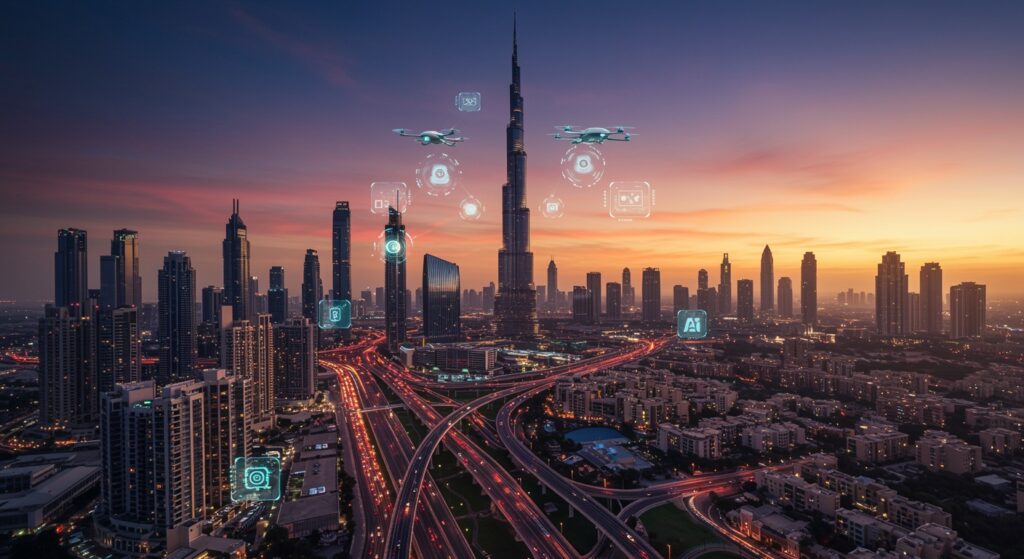
Dubai has never been a city that thinks small. From the world’s tallest tower to one of the most ambitious smart-city agendas anywhere, scale and speed are part of its DNA.
So, when the Emirate announced that 25% of all trips in the city will be autonomous by 2030, it wasn’t perceived as a distant, futuristic dream that may or may not take place. This is a firm commitment that is rapidly progressing.
But its implications for the country go beyond roads full of self-driving cars. While most headlines focus on robotaxis and self-driving vehicles, that’s just the visible part of a much bigger framework. Beneath it sits an entire ecosystem of new infrastructure, services, data, and business models, many of which have little to do with building cars.
For entrepreneurs, this is where things get interesting.
What Is Being Planned?
Dubai aims to integrate practical, connected, and scalable autonomous technology across the transport system. This will involve taxis, buses, and last-mile services working alongside existing public transport systems. Supervised autonomous trials are underway, with fully driverless operations expected as early as 2026. By 2030, the plan is for autonomous transport to account for around a quarter of all journeys in the city.
Many cities talk about autonomous vehicles, but few are structured to roll them out at scale. Dubai is one of the exceptions. The Emirate combines centralised planning, peerless infrastructure and an excellent track record with public-private partnerships. But it’s also about mindset. Dubai has a long history of piloting emerging technologies early, learning quickly, and improving as it goes. This is exactly how autonomous systems need to be introduced.
Together, these factors allow Dubai to move beyond small pilots and into practical, everyday autonomous-vehicle use much faster than cities constrained by fragmented governance or ageing infrastructure. However, focusing solely on vehicles misses the bigger business opportunities.
History suggests how this will play out. The winners of the smartphone race were not the phone manufacturers but the platforms, services and ecosystems that formed around them. Autonomous transport will follow a similar pattern.
Identifying The Untapped Opportunities
Fleet Operations And Lifecycle Services
Autonomous vehicles may not have drivers, but they still require constant human oversight behind the scenes. This creates demand in these areas:
- Fleet maintenance and servicing
- Predictive diagnostics and uptime optimisation
- Remote operations and monitoring centres
- Insurance models built specifically for autonomous risk
Fleet services often become more profitable than the vehicles themselves.
Smart Infrastructure And Urban Systems
Autonomous vehicles don’t operate in isolation – they depend on their environment being smart, connected, and predictable. This opens the door to opportunities, including:
- Upgrading intersections and traffic systems so vehicles can “read” signals, flows, and changes in real time
- Connecting cars to the city through vehicle-to-infrastructure communication that shares data on roads, signals, and hazards
- Installing sensors, cameras, and networks that feed constant information back into transport systems
- Creating digital maps and virtual testing environments where routes, traffic patterns, and scenarios can be modelled before anything hits the road
These are the elements of the autonomous environment that make everything else work, yet they’re often missed by entrepreneurs focused solely on the vehicles themselves.
Data, AI, and decision intelligence
Every autonomous vehicle is a data generator. That data fuels the following:
- Real-time route optimisation
- Predictive safety and maintenance
- Traffic flow modelling
- City-wide mobility planning
Companies that specialise in AI, analytics, cybersecurity and data governance will find themselves deeply embedded in the autonomous ecosystem, even if they never touch a vehicle.
In-vehicle experiences and new commerce models
When no one is driving, time inside vehicles becomes usable. This opens up new categories entirely, including:
- In-vehicle entertainment and streaming
- Location-based advertising and retail
- Productivity tools for commuters
- Premium autonomous travel experiences
Time is our rarest and most valuable commodity, and entrepreneurs who offer ways to maximise it will prosper.
Real estate and city reshaping
Autonomous transport changes how cities use space. As parking demand shifts and traffic flows improve, new possibilities open up, including:
- Repurposing existing parking spaces (mixed-use developments, public spaces, etc.)
- Creating mobility hubs where autonomous vehicles, public transport, and micro-mobility come together
- Increasing value in areas linked to autonomous routes, through improved access and travel times
- Taking new approaches to urban design, as planners rethink streets, kerbs, and pedestrian space
The biggest gains tend to go to those who spot them early and plan ahead.
Regulation and trust: challenges that create markets
Autonomous transport raises questions around safety, responsibility, and public confidence, creating opportunities for services including:
- Regulatory/advisory
- Compliance and certification
- Safety testing and validation
- Public education and user-experience design
Technological shifts also create demand for translators – companies that help people understand and adopt change.
The Driverless Future
Globally, autonomous transport investment is accelerating, with billions flowing into startups and infrastructure. But the biggest opportunities rarely go to those who arrive last.
Dubai’s 2030 target is closer than it sounds. The ecosystem is being built, partnerships are forming, early standards are being set, and it’s all happening now. By the time autonomous transport feels ordinary, the most strategic positions will already be taken.
Autonomous vehicles represent more than just self-driving technology – they redefine urban mobility and the utility of time. For entrepreneurs, the core challenge is not engineering the car, but reimagining life when the need to drive disappears. Dubai is already turning this vision into a lived reality.
About Author