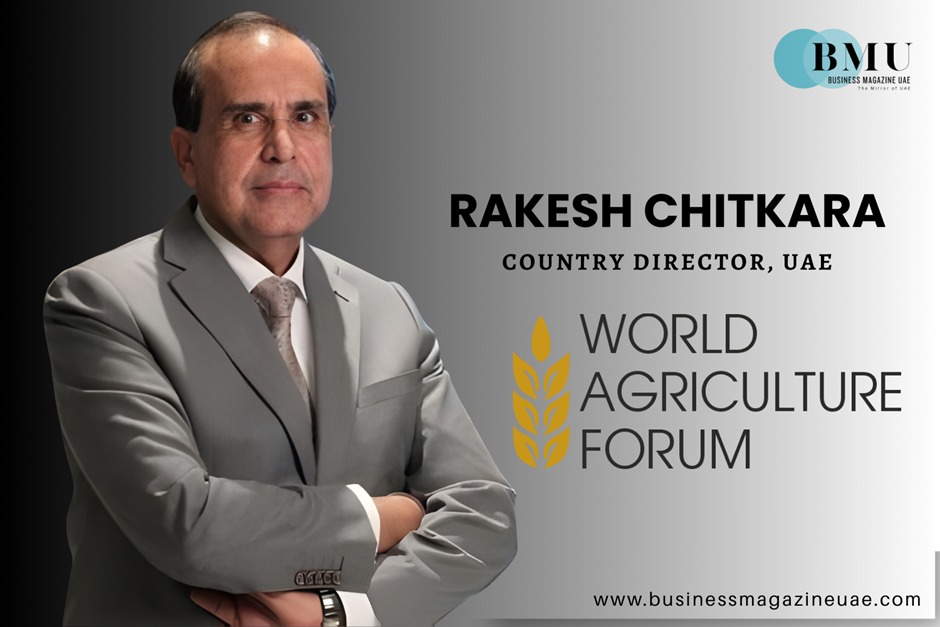
We recently had the privilege of interviewing Rakesh Chitkara, a trailblazing leader with more than three decades of experience in prominent leadership roles in multiple sectors, including infrastructure, agriculture, healthcare and aviation, supporting large global corporations. Currently serving as the Country Director, UAE at World Agriculture Forum, Rakesh empowers in shaping the agriculture and food security ecosystems, driving growth for economies, and long-term resilience aligned to the UAE’s food security goals. Additionally, as a columnist in The Daily Guardian, The New Delhi Post and Agriculture Today, Rakesh Chitkara shares his views on policies, innovation, trade, and beyond, leaving an important mark as a visionary leader.
The Beginning
We started the interview by asking, “What first inspired you to pursue your current professional path? Was there a defining moment or influence that shaped your direction?”
Rakesh shared, “My professional journey has been shaped not by a single defining moment, but by a gradual realisation over time. I came to believe that sustainable progress happens at the intersection of business, policy, and society’s needs. Early in my career, working across agricultural inputs, chemicals, and healthcare industries that are highly regulated worldwide, I saw how policy decisions directly affect markets, access, and outcomes, directly impacting the consumers.
This exposure deepened my interest in working upstream, engaging with governments, institutions, media, and global platforms to help align commercial growth rooted in public priorities. My current role in the agriculture and food security ecosystem reflects that evolution: moving from managing businesses to helping shape ecosystems that matter to economies, livelihoods, and long-term resilience.”
Navigating through Challenges
To learn more about the challenges Rakesh Chitkara came across in his career trajectory, we asked, “Can you describe one significant challenge you’ve faced in your career or business, and how you successfully overcame it?”
“One recurring challenge has been navigating complex, multi-stakeholder environments where interests are not always aligned. Governments, global corporations, local businesses, and civil society often operate on different timelines, objectives, and incentives.
The solution has never been force or speed, but credibility and patience for long-term sustainability. I learned early that trust is the most valuable currency in such settings. By listening carefully, respecting institutional processes, and focusing on long-term value rather than short-term wins, I have strived to build consensus and move difficult conversations forward. Over time, this approach has proven far more durable than transactional success,” he mentioned.
Potential Trends of the Industry
We even asked Rakesh Chitkara to share his perspective on the key trends or changes he envisions shaping the future of his industry over the next 3–5 years.
Rakesh reflected, “In agriculture, food systems, and allied sectors, three trends stand out. First, food security is no longer just about agriculture or growing more crops; it is a national security issue, a global trade concern, and central to efficient climate management. Governments will play a far more active role in shaping supply chains and partnerships.
Second, agri-commerce will become as important as production. Logistics, processing, storage, and trade corridors will determine who captures value.
Third, sustainability will shift from narrative to enforcement. Metrics, traceability, and accountability will increasingly define market access and investment decisions.
The UAE is particularly well-positioned to lead this transition, given its logistics strength, policy clarity, and global connectivity.”
Plans we asked Rakesh Chitkara
We then asked, “What are your long-term aspirations for your company or role, and what strategies are you implementing to reach them?”
He explained, “My long-term aspiration is to help position the UAE as a credible global connector in agriculture and food systems, linking production regions, innovation hubs, capital, and markets. To be an agri-commerce hub!
Strategically, this requires building platforms that are policy-aligned, commercially relevant, and globally networked. It also means shifting the conversation from isolated projects to collaborative thinking, where governments, businesses, and institutions participate with clarity of roles. My focus is on institution-building rather than personality-driven leadership, ensuring continuity and impact beyond individuals.”
Adapting to Emerging Technologies
With the digital revolution revolutionising business operations, we asked Rakesh Chitkara, “How do you see artificial intelligence and emerging technologies influencing your industry or business model?”
“Artificial intelligence will be transformative, but not in isolation. In agriculture and the food value chain, AI’s real value lies in decision intelligence, optimising water use, forecasting demand, managing logistics, reducing waste, and improving traceability.
The future belongs to practical, scalable innovation, not experimental pilots that cannot be commercialised or adopted by stakeholders on the ground,” Rakesh mentioned.
Values Guiding Rakesh Chitkara Forward
Interested to learn more about the leadership approach of Rakesh Chitkara, we asked him to share the core values or guiding principles that influence his decisions and the way his organisation operates.
Rakesh explained, “Three principles guide my work consistently. First, credibility over visibility. For me, impact matters more than headlines. Secondly, I believe in alignment over confrontation, as sustainable outcomes emerge when interests are aligned, not imposed. Thirdly, long-term thinking matters; be it in policy, investment, or leadership, durability matters more than speed.
These values shape how I engage with partners, governments, and teams, and they have served me well across sectors and geographies.”
Embracing Innovative Practices
Innovation is the key to success for any business. We asked, “Can you share an innovative strategy or approach that helped your company stand out or achieve a breakthrough?”
He mentioned, “While not specific to my current portfolio or company, one approach that has consistently delivered results throughout my business career is reframing conversations. Instead of presenting initiatives as sector-specific or organisation-centric, I position them within national or regional priorities, such as food security, economic resilience, sustainability, or trade competitiveness.
This shift changes the nature of engagement. Stakeholders move from asking — ‘What do you want?’ to, ‘How does this help us achieve our goals?’ That reframing unlocks collaboration, mutual support, and long-term partnerships that would otherwise remain inaccessible.”
Evolution as a Leader over the Years
Lastly, we asked, “How has your leadership style evolved throughout your journey, and what lessons have shaped your approach to leading teams or businesses?”
“Earlier in my career, leadership meant direction and execution. Today, it means creating clarity and enabling others. Experience has taught me that strong teams do not need constant instruction or supervision; they need context, trust, and accountability.
The most important lesson has been this: leadership is less about being right and more about being responsible-responsible for people, institutions, and outcomes that extend well beyond one’s own tenure,” Rakesh added.
Rakesh is based in Dubai and can be connected on LinkedIn to gain industry insights or at rakesh.chitkara@worldagricultureforum.org
Also Read:-
Gareth Hazelden: From Fitness To Business Success
From Turnarounds To Timeless Brands Nisreen Shocair
About Author