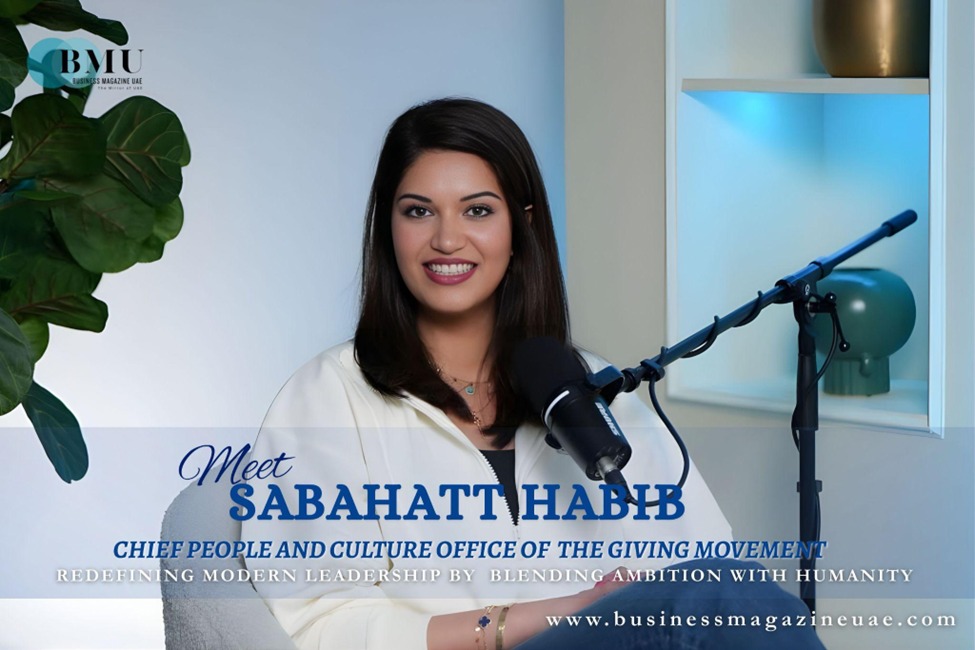
We recently had the opportunity to speak with Sabahatt Habib, Chief People and Culture Officer (CPO/CHRO) of The Giving Movement. Known for her disciplined yet deeply human approach to leadership, she is part of a new generation of executives redefining how performance, culture, and accountability intersect.
At the helm of large-scale People Transformation and HR Strategy within one of the Middle East’s fastest-growing omnichannel fashion brands, Sabahatt does not view People & Culture as a support function. She views it as strategic infrastructure. Under her leadership, people strategy has become directly linked to business performance, leadership maturity, and long-term sustainability.
Beyond her executive role, she is a keynote speaker and podcast guest, contributing to conversations around leadership accountability, cultural architecture, and the evolving human dimension of work in an AI-driven era.
The Beginning
We began by asking, “How did your professional journey begin, and what key moments shaped where you are today?”
Sabahatt shared:
“My journey began without a master plan. I needed to work. Like many people early in their careers, I was focused on opportunity rather than a predefined title. I explored marketing and sales roles before fully understanding what HR even meant.
People and Culture found me before I found it. What started as a role became a responsibility I could not ignore.
I worked in environments where results were prioritised but psychological safety was not. Those experiences shaped me deeply. They taught me that culture is not what is written in policies. It is what people experience when things go wrong.
That was the turning point. I realised leadership is not about authority or visibility. It is about responsibility. Responsibility for the environment you create. Responsibility for the impact of your decisions. Responsibility for the long-term trust people place in you.
Leadership is not about being impressive. It is about being accountable for the consequences of your influence.”
The Role of a Chief People Officer
We then asked, “How would you describe your role as a Chief People Officer, and what responsibilities matter most at that level?”
She explained:
“At executive level, the role of a CPO is not operational. It is architectural.
You are designing the behavioural system of the organisation. You are shaping how leaders lead, how performance is defined, how accountability is applied, and how decisions are experienced across the business.
At scale, culture cannot be accidental. It must be intentional, measured, and reinforced.
My focus is alignment. Business strategy, leadership behaviour, performance standards, and people care must reinforce each other. When those elements drift apart, performance eventually suffers.
One of the most critical responsibilities at this level is having the courage to challenge. Sometimes that means asking difficult questions in boardrooms. It means protecting long-term trust over short-term comfort.
A CPO must act as a bridge between board expectations, executive execution, and employee experience. That requires judgment, discretion, and emotional maturity. Growth should not come at the expense of dignity. High performance and humanity are not competing forces. When structured correctly, they accelerate each other.”
The Shift Modern Leadership Requires
We asked her what fundamental shifts organisations must make today.
She responded:
“The most important shift is moving from transactional leadership to conscious leadership.
For decades, performance was measured primarily through output. But output is a downstream result. The upstream driver is environment.
Leaders must recognise that psychological safety, clarity, and fairness are performance multipliers. When these are absent, engagement declines and metrics follow.
As AI reshapes industries, technical capability alone will not differentiate leaders. What cannot be automated is judgment, ethical reasoning, emotional regulation, and clarity under pressure.
These are often referred to as soft skills. In reality, they are structural skills. They determine whether organisations sustain performance or slowly erode it.
Managers must evolve from task supervisors to energy regulators. Culture is not built in strategy decks. It is built in daily behaviour, especially when pressure rises.”
Leading Through Growth and Pressure
When discussing challenges, Sabahatt reflected:
“Scaling rapidly while protecting values is one of the most complex leadership challenges. Growth tests systems, communication, and maturity simultaneously.
There are moments where shortcuts are tempting. Prioritising fairness, transparency, and long-term trust over short-term speed requires discipline.
Under pressure, people look for steadiness. I have learned that clarity, consistency, and ownership matter more than perfection.
You do not need to have every answer. You need to be accountable for your decisions and calm in your delivery.”
Technology and the Human Dimension
On AI and technology, she offered a nuanced view:
“AI will transform the mechanics of work, but not the essence of leadership.
It will enhance data visibility and operational efficiency. In People & Culture, it allows us to be more predictive and consistent. But technology does not replace judgment. It does not replace ethics. It does not replace empathy.
The organisations that thrive will be those that use AI to strengthen human capability, not diminish it. Technology should create space for better leadership, not remove it.”
The Future of Work and Accountability
Looking ahead, Sabahatt sees a shift toward maturity.
“We are entering an era where employees expect coherence. They expect alignment between what leaders say and what they do.
Transparency, fairness, and ethical leadership will not be optional. Organisations that treat people investment with the same discipline as financial investment will outperform.
Revenue and humanity are not trade-offs. They are interdependent variables. Sustainable growth is only possible when both are structurally aligned.”
Advice to Emerging Leaders
When asked what advice she offers aspiring professionals, Sabahatt concluded:
“Do not rush the title. Build capability. Build self-awareness. Build credibility.
Reputation compounds. Integrity compounds. Emotional maturity compounds.
Impact is not created through noise. It is created through disciplined consistency.
If you can hold ambition and humanity in the same hand, you will build something that lasts.”
Connect with Sabahatt Habib on LinkedIn to gain industry insights.
Find The Giving Movement on LinkedIn and visit https://thegivingmovement.com to learn more.
Also Read:-
Issam Mhanna: Turning Every Space Into A Timeless Experience
About Author