From Riyadh’s concert halls to Dubai’s waterfront promenades, a new rhythm is emerging in Gulf cities, and it’s keeping the lights on long after sunset.
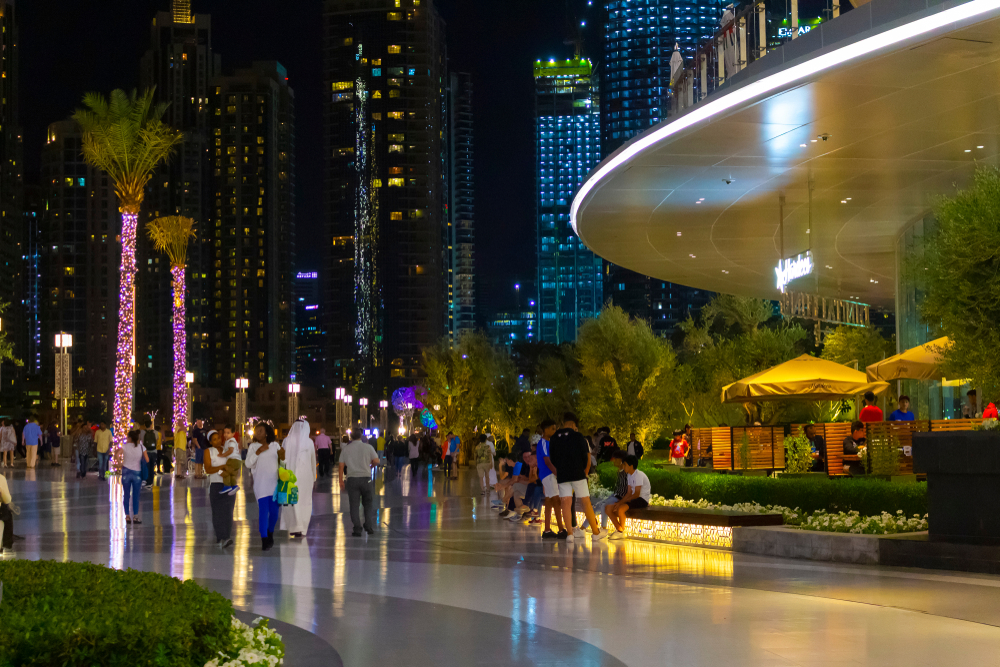
There’s a particular kind of energy that descends on Gulf cities as the sun disappears. The intense heat retreats, the air softens, and something shifts. Restaurants fill up, families spill out onto corniche promenades, and friends gather at rooftop cafes and shisha lounges that didn’t exist five years ago. It’s easy to take all this for granted, but what’s happening after dark in cities like Riyadh, Dubai, Doha, and Abu Dhabi is far more than a lifestyle shift. It’s an economic transformation.
The concept of the evening economy – the cluster of commercial and social activity that takes place between 6 pm and midnight – is not new in global cities. London, Barcelona, and Melbourne have long understood that how a city behaves after dark says a great deal about its character, its competitiveness, and its capacity to attract and retain talent. But in the Gulf, this story is still being written, and the stakes are exceptionally high.
Under The Shade Of The Moon
Let’s start with the obvious: the Gulf is hot, relentlessly so. For much of the year, daytime outdoor temperatures make prolonged activity outside not just uncomfortable but genuinely hazardous. More than a minor inconvenience, this is a fundamental shaper of urban behaviour. Gulf cities have long been car-dependent by design and necessity, with life largely conducted in air-conditioned interiors. The evening is, in many ways, the gift the climate gives back.
Research on walkability in GCC cities has highlighted that the region’s urban layouts have historically prioritised the private automobile, making pedestrian life difficult. This situation is changing, and the evening is central to how it’s changing. Smart urban planners are beginning to design around the cooler hours by widening promenades, investing in shaded outdoor spaces, and scheduling events and cultural programming deliberately into the post-sunset window. In this sense, the evening economy isn’t just a commercial opportunity, it’s the natural response to an environment that demands creativity about when and how public life is lived.
Vision, Strategy, And The Business Of Entertainment
None of this is happening by accident. The Gulf’s most significant economic development blueprints have, in one way or another, placed leisure, entertainment, and the quality of urban evenings at their centre. Saudi Arabia’s Vision 2030 explicitly calls for a “vibrant society” built around culture, entertainment, and sport as pillars of post-oil diversification. The Kingdom created an entirely new General Authority for Entertainment to oversee this shift, investing billions of dollars into the sector. Riyadh Season, an annual festival of concerts, events, and attractions that transforms the capital each winter, is perhaps the most vivid expression of this new ambition.
It is estimated that GCC governments could generate an additional USD 3.4 billion annually by aligning leisure and entertainment investments more precisely with what consumers actually want. That figure is striking – but, perhaps more crucially, it is a recognition that the demand is already there.
Gulf populations are young. Saudi Arabia’s median age sits in the upper 20s, and in Dubai, six in ten residents are under 35. These are populations that expect and desire rich evening lives with live music, dining experiences, cultural events, and sporting occasions. For years, the supply side lagged badly behind. Now, governments and developers are racing to close that gap.
The UAE, Qatar, and Bahrain have each embedded leisure and entertainment goals within their national visions, with a particular emphasis on arts, culture, and national identity. Recent research has found that arts and culture have now overtaken retail and coastal leisure as the top motivators for visitors across Qatar, the UAE, and Saudi Arabia. That’s a meaningful shift. For decades, Gulf cities were synonymous with shopping, with the mall as the civic centre. The evening economy suggests something more complex and more vibrant is emerging.
More Than Entertainment – This Is About Urban Redesign
There’s a temptation to think about the evening economy purely in terms of headline events such as Formula One races, global music festivals, and celebrity-chef restaurants. These things matter, but they’re the surface layer. The deeper question is about how Gulf cities are physically and socially restructuring themselves to support a sustained, everyday evening culture rather than a series of spectacles.
Transit-oriented development is a telling indicator here. Research comparing Doha’s West Bay and Riyadh’s King Abdullah Financial District has examined how Gulf cities are beginning to grapple with the challenge of building mixed-use, walkable districts that genuinely animate street life The World Bank’s broader work on urban liveability shows that cities that connect people to amenities, public spaces and each other, on foot and at a human scale, are more economically productive and socially cohesive. Historically, this has been a challenge for Gulf cities. The private car, the mall atrium, and the gated compound don’t naturally generate the spontaneous, layered public life that makes a city feel alive after dark.
What’s encouraging is that city planners in the region appear increasingly alert to this. New developments such as the Boulevard Riyadh City, Abu Dhabi’s Saadiyat Cultural District, and Doha’s Msheireb Downtown, are being deliberately designed with evening vitality in mind. Pedestrian-friendly streets, mixed-use ground floors, cultural anchors that draw footfall and keep neighbourhoods animated across the whole evening, are more than real estate plays. Done well, they are attempts to reshape the social fabric of cities.
A little friendly competition
There is also, perhaps, a little regional competition at play. Dubai spent decades carefully building its position as the Gulf’s premier destination for tourism, nightlife, and expatriate living. Riyadh’s emergence as an entertainment capital, hosting everything from heavyweight boxing to international music festivals, directly challenges that positioning.
This competition, ultimately, is healthy. It raises standards, forces innovation, and means that residents and visitors across the region benefit from an improving ecosystem of evening experiences. It also pushes cities to think more carefully about what genuinely makes them distinctive. An evening economy built on authenticity, such as neighbourhood character, local food culture, homegrown music scenes, and genuine cultural programming, will outlast one built purely on imported spectacle. The cities that understand this distinction will build something more durable.
The Questions That Need Answering
None of this is without complexity. The evening economy raises genuine questions that city leaders would be unwise to sidestep. Who benefits from it, and who is left out? A thriving restaurant scene and a world-class music venue are wonderful, but they don’t serve everyone equally. Many live lives that are far removed from the glittering evening districts being built.
There’s also the question of sustainability – not just environmental, but social. For tourism and leisure investment to truly pay off, it requires a stable, service-minded workforce and a clear, coherent vision of what kind of destination a city wants to be. Piecemeal investment in spectacle, without that underlying coherence, tends to produce a disjointed experience that neither residents nor visitors find satisfying over time.
And then there is the quieter question of cultural identity. Gulf societies are navigating a genuine tension between openness and tradition, between a desire to compete globally as cosmopolitan, vibrant cities and a deep commitment to values and ways of life that have defined these communities for generations. The evening economy sits at the centre of that tension. How it unfolds – who it includes, what it celebrates, what it asks people to leave behind – will say a great deal about the kind of cities the Gulf is choosing to become.
Watching The Lights Come On
The remarkable development occurring in Gulf cities right now needs to be understood on its own terms, not as an imitation of Western urban models or a marketing strategy, but as a serious, complex, and still-evolving response to real demographic pressure, genuine economic necessity, and a deep human desire for a richer shared life.
The evening economy is, at its best, the economy of belonging. It’s where cities earn the loyalty of their residents and where people, consciously or not, decide this is a place worth staying in, investing in, and building a life around. For Gulf cities that have spent decades competing on gleaming infrastructure and megaproject ambition, the invitation now is to compete on something harder to manufacture and more lasting in value: the quality of an ordinary evening.
About Author