
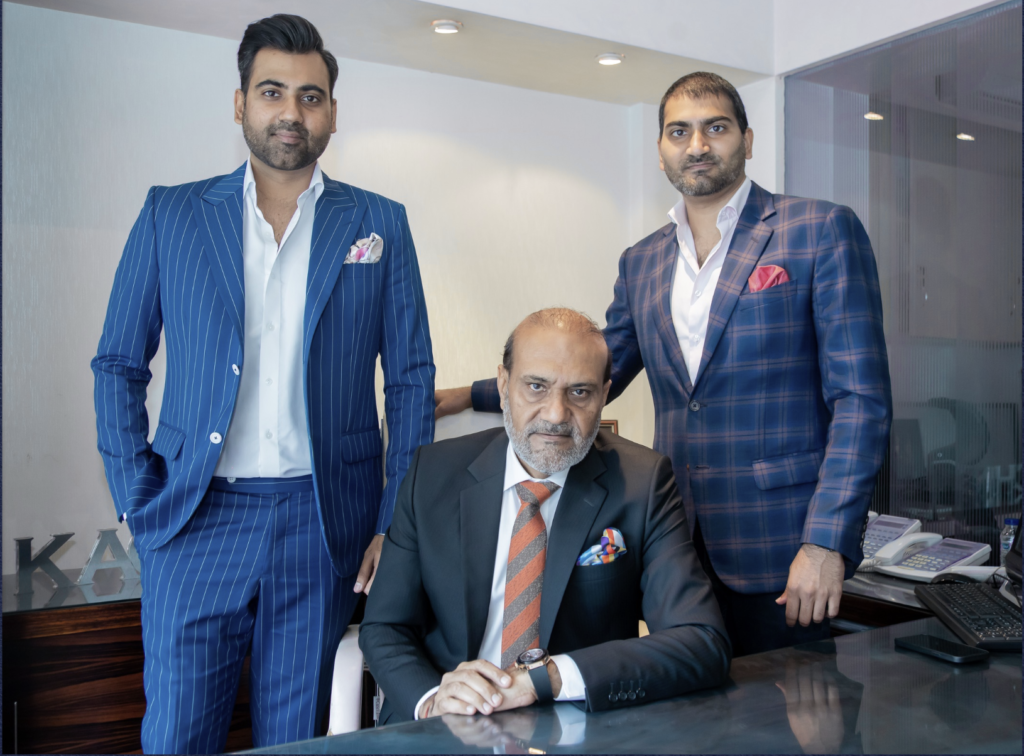
Some businesses arrive with noise. Others take root quietly, almost stubbornly, until an entire market learns to orbit them. Kachins belongs to the second kind, and its story cannot be told apart from the country that gave it room to grow. The UAE, from the moment it began building itself into a global crossroads, has always rewarded the patient over the loud, the deliberate over the hurried. Kachins is what that patience looks like, four decades on.
Ashok Ramchandani: The Discipline That Started It
When Ashok Ramchandani arrived in Dubai in the mid-1970s, the city was still sketching its own commercial identity. The skyline had not yet learned its ambition, and the notion of luxury tailoring as a structured industry barely existed anywhere in the region. Tailoring, where it existed at all, was practical work: necessary, fragmented, and rarely mistaken for craft.
In 1981, he opened a small workshop in Bur Dubai with seven artisans. There was no excess, no spectacle, only a room defined by fabric, discipline, and a quiet insistence on getting things right. The years that followed asked more of him than any business plan could have anticipated. Demand moved unpredictably. Resources were thin. Reputation had to be earned one client, one garment, one fitting at a time, and there was no shortcut through any of it.
What set his approach apart was never scale. It was steadiness. While others chased quick turnover, he invested in method: multi-stage fittings as standard practice, master cutters kept central to every garment, client measurements preserved with a care that turned transactions into relationships. By 1989, that discipline had translated into visible momentum. The move from a modest 690 square feet to a 3,000 square foot, multi-level store was not merely more space. It was a philosophical shift, bringing tailoring and fabric sourcing under one roof and giving the business, for the first time, a structure equal to its ambition.
That same intent shaped how Kachins built its fabric library, never by volume, always by conviction, drawing on mills across Italy, Switzerland, and the United Kingdom whose textiles were chosen for structure and longevity rather than name alone. Growth followed, but never at craft’s expense. A team of seven became more than 120 professionals. A handful of garments became thousands of pieces a year. A clientele that once trickled in has, in the decades since, returned with a loyalty rare in retail of any kind, roughly eight in ten clients coming back fitting after fitting, generation after generation.
Today, Kachins stands as one of the UAE’s enduring tailoring houses, not because it expanded the fastest, but because it refused to dilute what made it credible in the first place. There is a resilience in that choice that does not announce itself. It simply becomes evident, decade by decade.
Ravi and Neetu Ramchandani: The Discipline, Carried Elsewhere
The discipline Ashok built did not stay contained to one generation, or one direction. Ravi and Neetu, his elder children, grew up inside the business, learning its rhythms years before it opened its doors beyond Dubai, and carrying that same instinct for steady, deliberate growth into their own paths.
Ravi’s path has since widened beyond tailoring. In 2015, a series of trips through West Africa alongside his father sparked the idea for Kenzol, a lubricant and grease manufacturer he now leads as Founder and CEO, today reaching more than 40 countries from its base in Sharjah. The same region that would later welcome Kachins’ own expansion into Abuja had, years earlier, planted the seed for a business entirely outside fashion. It is the kind of range a market like the UAE makes possible, one where ambition is rewarded rather than boxed in, and where a family that earned its name in couture can just as credibly build one in industry. That instinct says something about the Ramchandanis: a willingness to follow opportunity wherever it leads, and a country that keeps giving them reason to.
Anil Ramchandani: The Discipline, Given Velocity
If Ashok built the foundation, Anil Ramchandani brought velocity to it. Educated in tailoring and fashion in London, he returned with a vocabulary that reached beyond craftsmanship into positioning, design language, and the architecture of global business. By the time he joined Kachins in 2012, the question facing the house was no longer survival. It was direction, and he answered it decisively.
His influence is best understood not as departure from the original model, but as its amplification. Precision, personalisation, and continuity remained exactly where Ashok had placed them. What changed was the frame around them, widening year by year to hold a larger ambition.
Under his leadership, Kachins began moving outward with intent. The opening at Bay Square in 2015 quietly set that direction, placing the brand inside one of Dubai’s most active business districts, surrounded by firms spanning real estate, consulting, finance, design, and technology. The launch in Abu Dhabi in 2016 marked the first clear step beyond Dubai’s borders, positioning Kachins within the capital’s more formal, institution-driven luxury market. From there, the trajectory only sharpened.
The entry into West Africa in 2022, anchored by a flagship at the Hilton Abuja, introduced the brand to a clientele with its own long and rooted appreciation for bespoke dressing, a market Kachins has now called home for years, not one it is newly discovering. By 2023, the opening at One Central, World Trade Centre, reinforced Kachins’ place along Dubai’s evolving commercial spine, aligned with a newer generation of professionals for whom precision, speed, and personalisation matter in equal measure. And for clients beyond even these addresses, in Sharjah, Ajman, Ras Al Khaimah, and Fujairah, Kachins built a structured home and office visit model: consultations arranged online, then carried in person to wherever the client happens to be, so that no location stands between a client and the same exacting standard of fit.
Trunk shows became another expression of that same outward reach, carrying the Kachins atelier into cities the brand had not yet opened a door in, proof of concept before commitment of address.
Alongside this geographic reach came structural evolution. A global digital platform, introduced in 2025, redefined access itself, letting clients engage in bespoke tailoring remotely without surrendering an ounce of detail or experience. The garment stayed central. The conversation around it simply grew larger.
None of this arrived without resistance. The years that tested businesses everywhere tested Kachins too, and where many retreated, Kachins chose to keep building, meeting global disruption with the same steadfastness that had carried it since 1981.
The strategic direction today carries real clarity: West Africa as a high-growth luxury corridor already proven, the GCC, particularly Saudi Arabia and Qatar, as the next frontier, and beyond geography altogether, a larger ambition still, to stand not as a regional tailoring house but as an internationally recognised bespoke brand.
Positioning and Recognition
Publications have taken note of the distance travelled. Gulf Business has documented Kachins’ four-decade journey, drawn to its operational depth and its craftsmanship. Arabian Business acknowledged the house’s next phase of leadership by naming Anil Ramchandani among its Indian Aces of 2025, a marker of influence extending well beyond the tailoring trade. Esquire Middle East, meanwhile, has turned its attention to the brand’s evolving design sensibility, the meeting point of tradition and modern tailoring that Kachins occupies almost alone in the region.
What emerges, looked at closely, is not simply a company’s timeline. It is a study in continuity across an entire family and an entire country. A founder who understood that credibility is earned slowly. Two elder children who carried that same discipline into paths of their own, one of them building an entirely new industry on the back of it. A younger son who recognised that scale, handled carefully, does not have to erode what made the house credible to begin with. Together, across three lives and one shared instinct, they have shaped Kachins into something rarer than growth alone: a legacy that still feels alive, still in motion, built inside a country that has never stopped making room for it to become more.
About Author