
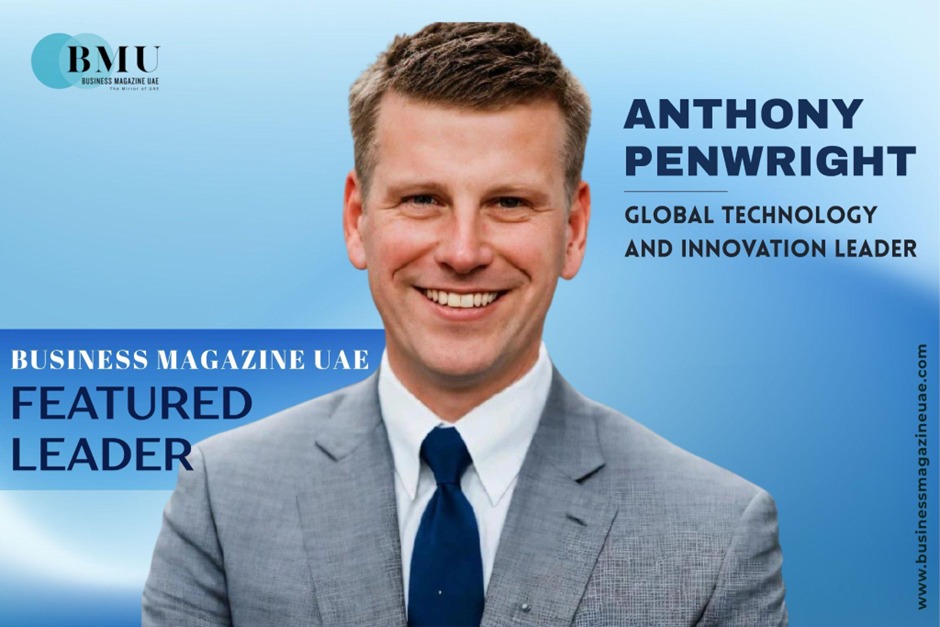
We recently had the opportunity to engage in an insightful conversation with Anthony Penwright, a distinguished technology and innovation leader with more than two decades of global experience delivering complex digital transformation programs valued at over £1 billion. His career spans senior leadership roles at organisations including NEOM, Cisco, and the UK Government.
He brings an exceptional track record in strategic planning, innovation ecosystem development, stakeholder management, and leading cross-functional teams of 450+ resources to achieve operational excellence and financial success. As an expert in Smart Cities, IoT, AI, and Blockchain, Anthony Penwright has delivered success at the CXO level across Cisco, Wipro, the UK Government, and NEOM.
The Beginning
We started the interview by asking, “What first inspired you to pursue your current industry or professional path?”
Anthony shared, “I initially joined the Police Force. I’d sought that career for stability after some challenges as a late teenager – I wanted security. But it didn’t take long to realize that while I loved helping people, I was more passionate about the technology that enabled things to get done than the frontline work itself.
I had a leader at the time who saw something in me. He said, ‘You have a gift with both technology and people – and technology is going to be the next big thing.’ This was 22 years ago.
I took a leap of faith. Used the finances I’d saved to get professionally qualified in IT, and that decision shaped everything that followed. What’s made my career successful isn’t just the technical knowledge – it’s combining that with the people skills I developed early on. The ability to bridge both worlds has taken me from the UK Government to global programs across multiple sectors and continents.
I’m grateful and humbled about where that advice led me.”
Navigating through Challenges
To understand how Anthony Penwright handles challenging phases, we asked, “Can you describe one significant challenge you’ve faced in your career?”
He explained, “Every challenge I’ve faced ultimately comes back to one thing: people. If you can’t get people right, nothing else works.
Think about it – we’re born from people, raised by people, our careers depend on people, and our pay comes from people. I learned early, through some hardship, that navigating relationships – whether task-oriented or social – is the critical skill for any successful outcome.
The most significant professional challenges I’ve faced have been large-scale transformations, when organizations want to completely shift direction, introduce new ways of working, and change their entire operating model. These are brave decisions, but humans are naturally resistant to change.
I’ve found the best approach is empathetic leadership. You have to solicit buy-in, enable understanding through communication, and bring energy to the desired outcome. This isn’t IQ work – it’s EQ and SQ work. People need to feel validated; they need to feel included.
If you take a draconian view of change and ignore the human element, you’ll make every challenge ten times harder than it needs to be. The transformation programs I’ve led successfully – including at the UK Government with 450+ people, have all been built on that foundation of empathy first, then execution.”
Potential Trends of the Future
We then asked, “What key trends do you foresee shaping your industry over the next 3-5 years?”
“The obvious answer is artificial intelligence – but the nuance matters.
I see AI adoption accelerating exponentially across every part of business and personal life. It’s exceptional at task-oriented, code-oriented, productivity-oriented output. That’s not a trend; that’s already reality. The real trend to watch is how we manage the human side of AI adoption. One of the biggest fears I’m seeing is people genuinely worried about their jobs – and it’s a legitimate concern. AI will displace certain roles. So the organizations that succeed won’t just be the ones with the best AI – they’ll be the ones who navigate that change culture and human resistance effectively.
I also see significant challenges ahead around AI orchestration – building trust and ownership over how AI integrates into our processes. The ethical questions aren’t resolved. The governance frameworks barely exist.
I’m so convinced this will define the next decade that I’m currently completing an MBA in Artificial Intelligence alongside my executive role. The leaders who understand both the technology and the human change management will be the ones who thrive,” Anthony mentioned.
Plans we asked Anthony Penwright
Intrigued to learn more about his professional goals, we asked, “What are your long-term aspirations and strategies to reach them?”
He reflected, “I continue to thrive as a senior leader in large organizations – I genuinely enjoy that and want to continue to be authentic, loyal, and effective. But I also aspire to step outside the enterprise corporate structure and build something of my own.
My long-term aspiration is to create a world-class product and a genuinely human, culturally positive company. I believe a company is nothing without its people. They’re what make or break you, what determines whether you have a good day or a bad day. I want to build something where motivation is intrinsic because the company feels like a family.
I’m at the pre-seed phase now. I have a comprehensive, validated ideology for a product. The strategy is clear: seek investment, build the product, then bring in people who are the right cultural fit.
I’m happy to teach skills – that’s learnable. What I’m focused on is personality, emotional intelligence, ingrained attitude, and diversity. Everyone has value, and I want to create an environment where people have the freedom to be creative, express their views, and genuinely contribute. A product is of a company and its workforce – not of one individual. That’s my north star.”
Impact of AI across Sectors
Currently, AI is everywhere and is reshaping sectors. To understand Anthony Penwright’s perspective on this, we asked, “How do you see AI and emerging technologies influencing your industry?”
“I see AI fundamentally changing how companies develop products, market them, sell them, execute delivery, and continuously improve – all within the next 12 to 24 months, not years.
AI enables companies to do more with less. It shifts power from the age of the developer to the age of the strategic thinker, the creative thinker. That’s a positive change, though it will create saturation challenges – how do you identify what’s genuinely good?
What excites me is the opportunity for nascent companies. They can respond rapidly, align to customer needs quickly, without the barriers of enterprise architecture, enterprise politics, and monolithic solutions. The playing field is leveling.
In my current domain – construction, this is especially significant. Construction, like several major industries, has enormous untapped potential when it comes to building mature digital ecosystems. I see AI and emerging technologies enabling positive workflows, real-time traceability, and accountability through field solutions that give the right knowledge to the right person at the right time with the right context. Whether you’re a CEO or a site supervisor.
Business models will fundamentally change. Workflows will be digitized end-to-end. And workforces will become dramatically more productive. That’s not a prediction – it’s already beginning,” he stated.
Guiding Values at Business
Interested to know what core values or guiding principles influence Anthony Penwright’s decisions, we asked him to share the same.
Anthony shared, “In commercial business, revenue is foundational – that’s reality. So my guiding framework starts there: Does this initiative save money? Does it create money? Does it deliver against KPIs? Does it align with strategic goals, national visions, or our corporate social responsibility?
I operate with empathy first. I believe in understanding people’s frames of reference – not everyone has the same culture, background, or capability. Decisions that ignore the human element might look good on paper but fail in execution.
I also believe in transparency and governance. In complex environments – whether government, mega-projects, or enterprise, I’ve found that structured frameworks create trust. Clear accountability, honest assessment of risks, and early communication of problems build credibility.
And finally: always be willing to do what you’re asking others to do. I lead by example, stay present with my teams, and make myself approachable. If you build a foundation that supports your team, they will always give back when it matters.”
From Setbacks to Success
We asked, “Can you share an innovative strategy that achieved a breakthrough?”
“I’m six weeks into my current role, so let me share what’s worked in the past. Successful innovation requires an ecosystem, not just ideas. Here’s the framework I’ve implemented:
First, define problems properly. Not requirements with solutions attached – genuine business needs with clear objectives and key results. What does good look like? What’s it worth to solve?
Second, build your supply ecosystem. Government bodies, institutes, accelerators, VCs – you need a mature pipeline of innovative products to evaluate against your needs.
Third, prioritize toward execution. Everything worth testing gets a proof of concept in a controlled environment. This builds relationships with vendors and lets them demonstrate against your actual business needs.
Fourth, and this is where enterprises often fail, fix your commercial approach. Small innovative companies can’t survive the enterprise payment terms. The cash flow requirements, the unfavorable contracts, the monolithic procurement processes – they kill innovation before it starts.
In my previous role, I advocated for innovation to operate as an outside function with freedom: dynamic sourcing, flexible execution frameworks, and commercial terms that support startups, not strangle them. Innovation ecosystems need to be nurtured, not subjected to enterprise bureaucracy.”
Evolution of Anthony Penwright as a Leader
Lastly, we asked, “How has your leadership style evolved throughout your journey?”
“My foundation has always been empathy, and that hasn’t changed. But how I apply it has evolved significantly.
Early on, I saw leadership as an energy exchange. What I give to my team, they give back. When stress hits, when urgency arrives, teams I’ve led have always gone the extra mile – because we’d built that reciprocal foundation first.
I’ve always led by example. I’m willing to do anything I ask of others. I stay present with my teams rather than dictating from a distance. I want people to feel free to contribute – and to complain – so I understand their needs and can help motivate them and ensure they feel valued.
What’s evolved is my understanding of frames of reference. Not everyone has the same culture, background, or capability. Diversity isn’t just nice to have – it builds well-rounded, effective teams. I’ve learned to understand others’ perspectives before expecting them to understand mine.
I invest heavily in self-development outside work – whether that’s technical knowledge to understand someone’s problem, or psychology and human dynamics to improve how I build relationships.
Once that empathetic foundation is built, the task-oriented work becomes easy. The relationships carry the load,” Anthony shared.
Connect with Anthony Penwright on LinkedIn to gain industry insights.
Also Read:-
Eng Ahmed Motawakel: Shaping Vision, Building Connection
Discretion As A Discipline: Chad Allan’s Concierge Blueprint
About Author